
Sometimes you may feel as though you are beating your head against a brick wall. You set a practise schedule and you try to stick to it, but you just aren’t progressing. You could be making one of the following mistakes, all of which are easy to overcome:
Not actually practising. You intend to and you pop it into your schedule but it is never given the priority it requires and deserves. It requires a true commitment. Trust me, once you practise enough to get past those early learning hurdles, you will start to enjoy it much more and even look forward to practise.
Playing what you already know. It’s so much easier to keep playing the pieces you already play well and neglect the ones that require more effort, but you’ll pretty quickly become bored with your repertoire as well as not having a challenge.
Not reviewing old pieces to maintain a repertoire. Following on from the point above, you want to revisit older pieces occasionally so you can maintain a repertoire that has both volume and variety.
 Always starting from the beginning. If you start a piece at the beginning every time you play it, you will find you quickly become proficient at the start of the piece but less so as the piece goes on. I often tell my students to start at the part they find the most difficult, work on that part and then incorporate it back into the song.
Playing easier parts faster than the harder passages. If – as the point above suggests – you usually start at the beginning of a piece, you will probably play this part best and consequently a little faster. Then when you hit passages that require more concentration, you will slow down. From the time quavers are introduced to my students, I tell them to look at the hardest part (which at that stage is usually where the quavers are) and see at what speed they are comfortable playing that part. The rest of the piece is then played at this tempo. An added bonus is if that means the majority of the piece is feeling too slow, there is an added incentive to work on the troublesome section first to get it to the speed you want. Effective practise!
More common mistakes and how to fix them next month 🙂
If you are considering music lessons for your child or for yourself, please contact me to discuss the options. Piano lessons are conducted at my studio in Wallsend, NSW.
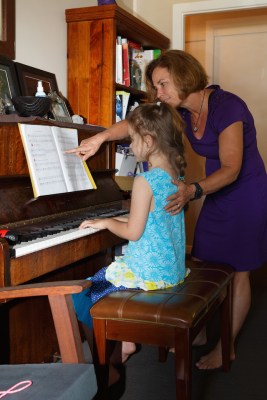 In this first part of a two-part post, we will look at some of the ways you can help your child that don’t involve the music itself. Part two (in two weeks) might surprise you with the ways in which you can be involved with the content of their practise.
 6. Ensure they are sitting correctly at the piano. Keep an eye on them and if you see them slouching, suggest they hold their back straight. This will not only stop body fatigue but will also help them balance their arms and hands properly. Their teacher should also be able to show you how they should be holding their hands, so you can keep an eye on that as well.
 merri bell music