
Aural training – or developing ‘a good ear’ – is such an important part of becoming a musician. It helps with everything from being able to harmonise through to simply recognising if you’ve made a mistake. But not everybody is born with a naturally good ear and even those who are can still learn to better refine it.
So how do we help our students develop their aural skills without the drudgery of drills and exercises? We use fun apps!
I initially reviewed this app nearly three years ago, but it has had a resurgence in my studio, with all current students really enjoying it, so it is worth revisiting it here.
 Blob Chorus by Lumpty Learning is one such app, which introduces students to basic pitch recognition in a fun way. It is used in thousands of schools around the world because it also works well in a group setting, but its simplicity means it is also totally suitable for individual lessons.
The premise of the game is simple: a number of green blobs have formed a choir and they are singing for King Blob (who is purple and wears a crown). Each blob sings a note and then King Blob sings a note. The note sung by the king is the same as a note sung by one of the blobs. But which one? This is what you need to identify.
 Although the game always opens with the default of three blobs, you can set the game to as little as two (which is the best place to start). As you improve, you can increase the number of blobs in the choir. The maximum is eight blobs, which is very difficult.
If the incorrect blob is selected, that blob will explode, but you are able to select another blob and continue doing this until the correct blob is selected. At any time you can click the ‘hear blobs again’ button at the bottom to hear the remaining blobs sing their notes again.
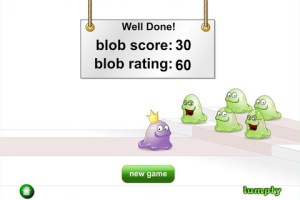 The game is separated into groups of ten questions; after each set of ten you will receive a score and an overall rating.
$1.49 on the Apple app store (but not for Android), the Apple version can be found here.
If you don’t own or have access to an iPad or Android tablet, never fear! The game is also available in a web version here; it just requires an internet connection.
They not only look cute, but they sound really cute as well 🙂
If you are considering music lessons for your child or for yourself, please contact me to discuss the options. Piano lessons are conducted at my studio in Wallsend, NSW.
 The Most Addicting Sheep Game is a seemingly simple rhythm app for the iPad where jumps and rolls must be perfectly timed to the music by tapping or swiping on the screen. It is easy to learn, but tricky to master.
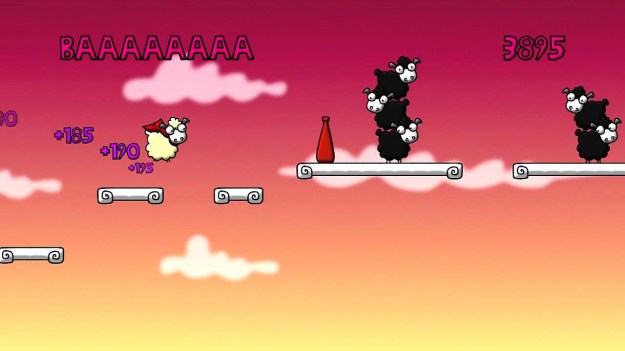 The sheep can jump at either one, two or four beats and can also jump two different height levels. An obstacle on the path – such as a tower of balancing sheep – requires a swipe to knock down. This means, as with most things to do with playing music, your brain is concentrating on multiple things at the same time. The picture above shows one beat and two beat lengths, a double jump and single jumps plus swipes. All of that would take less than five seconds to execute. Plus it all has to be done strictly in time with the music!
 The graphics are cute and the music is catchy. At first the music can be annoying – especially when you aren’t being successful – but all of a sudden you will find it’s an integral part of the mood and the fun.
 You can find it
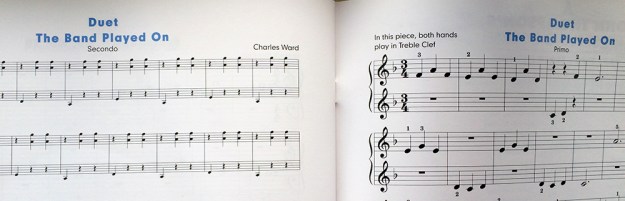 I still enjoy the fullness of sound a duet provides and regularly play a duet ‘together with myself’, where I record the Secondo (bottom part) on my digital piano and then play it back while I play the Primo (top part). Duets are certainly a special experience :-)
 Although the game always opens with the default of three blobs, you can set the game to as little as two (which is the best place to start). As you improve, you can increase the number of blobs in the choir. The maximum is eight blobs, which is very difficult.
 The two I use most are the first two, as they are great early ear training activities asking only to tell the difference between two things. Is the note played a high note or a low note and are the notes going up or down? The interface is easy… just tap the red circle to hear the sound and then drag the same circle to either Beethoven Bear or Mozart Mouse, depending on your answer. For example, the image on the right shows the ‘Notes Going Up or Down’ activity. The student taps the red circle and hears a succession of notes. If they think the melody is moving from lower to higher notes, they drag the circle up to Mozart Mouse sitting at the top of the staircase. If the think the melody is moving downwards, they drag the circle to Beethoven Bear.
 The app also has a simple rhythm exercise, using the note values that are commonly learnt in their first few lessons. Beethoven Bear and Mozart Mouse are each standing under a different rhythm. The student taps the red circle to hear a rhythm and then drags the note to the character standing under the rhythm they think is correct. Once again, the question needs to be answered correctly before moving on.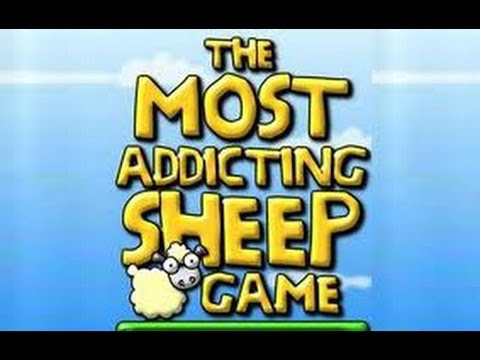
 These days we have so much technology at our disposal and it is always tempting to look for tools that are complex and multi-use because we feel the more they offer, the more useful they should be. But sometimes we are just making things harder for ourselves. It’s like trying to work out all the complexities of a smart phone, when all we really want to do is make a telephone call.
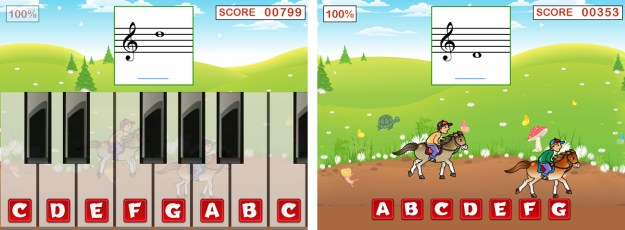
 The difficulty can be increased by adding more notes and/or speeding up the race. The speed is determined by whether you choose to walk, trot, cantor or gallop during your race. Before you know it, you’re an expert at naming the notes of the treble clef, the bass clef, or both.


 I have posted before about
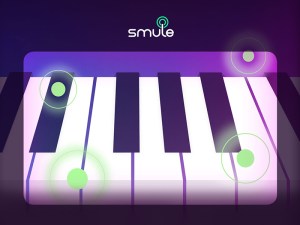 It may seem odd that I have selected an app that isn’t about learning the fundamentals like note recognition, timing or pitch. There is no keyboard and there are no note names.
 The basic premise is that balls of light – representing the notes of a song – drop down the screen towards a line. You need to tap these balls as they reach the line. Doing so in the correct combination and sequence will play the song correctly. The balls are spaced variably and need to be tapped in the correct location, so you aren’t passively staying in one place.
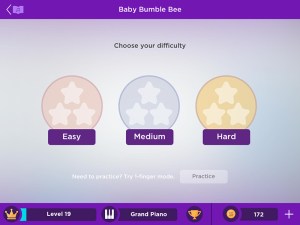 Three different levels of difficulty are available for every song – easy, medium and hard. The easy level contains single notes and two-note chords. The medium level includes three-note chords while the hard level moves up to four-note chords. There is also a range of difficulty in the songs themselves. For example, many of the old traditional pieces are written basically and are therefore simple, while a classical piece is much more involved. This means it is still incredibly useful (and fun) for total beginners but challenging for experienced musicians.
 merri bell music