Today I am revisiting an old post (with some additions), because it has become even more relevant lately.
Scales. Love them or hate them, scales are a big part of practise life for any musician (instrumentalist or vocalist). Arpeggios, broken chords and other technical exercises are also vital, but they build on scales, so scales are where we start this conversation.
It’s difficult to convince kids to play scales. I understand this (although I have always loved their structure and consistency) but refusing to practise technical work only hinders progress. The benefits for technique, style, rhythm, tone and aural awareness are all listed below, but there is also a big reason that relates to more recreational music…
 Chords! All the popular music that kids like to play revolves around chords. Chords are based on scales. If the scales flow freely from your fingers and the construction is understood, chords can come easily. Improvise with chords – with or without a melody line – and you can follow a lead sheet and play a vast range of songs.
Scales are the backbone of all types of music we play and each one of the variety of styles is defined by its characteristic interval pattern. It is the constant repetition of these patterns that causes scales to be such a large part of learning to play an instrument – including the voice – because they help build muscle memory. By playing scales, your fingers will learn to easily go to the correct notes in the scale you are playing, so when you play a piece of music, your fingers will move more automatically to the correct notes.
 Why practice scales?
- Scale practice plays an essential part in developing a pianist’s skills.
- They improve keyboard fluency.
- Scales develop posture, hand position and coordination, as well as balance between the hands and movement of the arm.
- Practising scales speeds up the learning of new pieces (muscle memory).
- They develop evenness of line and quality of tone.
- Scale playing builds aural awareness.
For students preparing for an exam, the examiner will be looking for:
- A positive sense of rhythm without under-accentuation;
- Even, firm tone and a musical curve;
- Good legato;
- Accurate and fluent realisation of the different types of scales, arpeggios and broken chords; and
- Convincing negotiation of technical challenges such as smooth passage of thumb and hand coordination.
So the lesson here is, whether for technique or pleasure, we need to learn to love scales. They are incredibly beneficial physically and the basis of all we do as musicians. All practise sessions should start with a variety of scales, even if their only purpose is to warm up the fingers and hands (although we know they do much more than that). To break up the repetitive nature of practising scales every day, apps such as Blitz Book’s ‘Scale Blitzer’ can add a bit of fun and variety.
If you are considering music lessons for your child or for yourself, please contact me to discuss the options. Piano lessons are conducted at my studio in Wallsend, NSW.
 Not just between your child and their instrument, but also between your child and music in general. There have been lots of studies proving the benefits of music to our brains, but these benefits won’t occur by just turning up to a 30-minute lesson once a week. They will also learn more about their instrument – how it feels, how it sounds, what it can do – and will become more attuned to how they can control what sound it can produce.
 To play an instrument, your child’s brain is processing a great number of details simultaneously, combining rhythm, pitch, technique, body positioning, fine motor skills, dynamics, texture, tonal shading and more. The synapses being developed in the brain of a musician are unique.
 Piano skills don’t instantly appear, but grow over time. Having a goal towards which they can steadily progress gives your child the opportunity to understand the concept of steady progress and delayed gratification.
 When they play sport, they accept they will have to go to training sessions. Many of them probably practise their ball skills at home. But they don’t call it practise.
 These days there are coaches for everything – fitness coaches, vocal coaches, sport coaches, diet coaches, life coaches, drama coaches, executive coaches, dance coaches. The list goes on and on.
 Try it out with your kids. Change the language. See if they are happier to rehearse or to train or even to prepare for their next coaching session. Modify the vocabulary and find what works for them. Whether we like it or not, neglecting practise – or not practising enough – is not going to get them anywhere. But perhaps rehearsing or training will.
 2. Set a goal. No matter what your level, from beginner to advanced, you can benefit from setting some practise goals. You may want to learn a new song, memorise a piece or even improve your sight reading. Set interim goals for yourself along the way so you can check in and make sure you’re on track.
 4. Listen. While this won’t actually exercise your playing muscles, it is a very important part of learning and studying music. Listen to lots of different pianists and listen to other instruments as well. Children tend to only know the music styles listened to by their parents, so its a good opportunity for them to be exposed to a variety of genres. One of my students has grown up with the classic rock of her parents but has recently discovered musical theatre soundtracks (thanks, YouTube). She is enthralled with how the mood of the music tells a story and often comments on “the power” she hears in songs. Expose your musical ear to all sorts of things. You won’t like them all, but you will find plenty you do like.

 We can use this philosophy to make piano practise less of a chore and make it easier to get ourselves to practise again. Save the best for last. Have a piece that you enjoy playing sitting on the piano ready for you to turn to once the more challenging parts of practise are over. Or finish practise with the piece that requires the least work. Set yourself up so that you end practise on a positive note and you will feel much more inclined to practise again the next day.
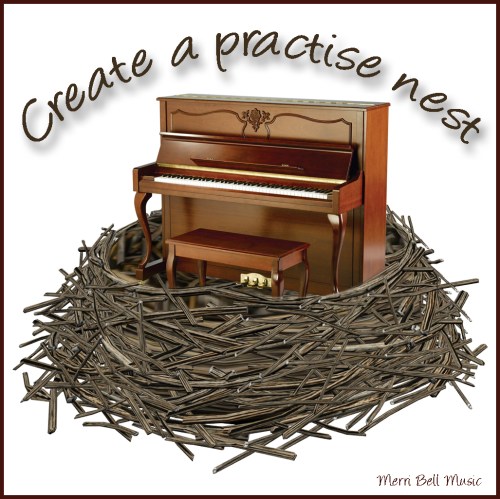 1. When choosing a location for your piano, select a space that is lived-in, welcoming, and well-lit. Keep it close to ‘the action’ but not in the action. Your children will gravitate to the piano more often if it is in a central place in your home. Avoid bedrooms, basements and other ‘put away’ places. Feeling shut-off from the family while practising will inevitably lead to a reluctance to spend time on the piano.
 However, for those who are going to be away from their piano for a period of time, standard practising obviously isn’t possible. I have
 The middle pedal:
 Following are some tips that can help you make the maximise the effectiveness of your practise time:
 4. Schedule your practise sessions – While this seems self-explanatory, this technique will only work well when in conjunction with the tip above – if you schedule in time, you must be prepared to give that time your full concentration. For some, the best time may be first thing in the morning when the mind is fresh (and you will feel accomplished at having started your day by completing a major task) while others may need to wait until the kids are in bed and the household jobs completed.
 7. Keep a practise journal – A practise journal is a log of your practice sessions, including what you practise and for how long. It can be a notebook, a Word document, a spreadsheet or whatever works for you. At the end of each practise session, write down which pieces you worked on and how long you spent on each one. This can serve to force your mind to focus and may also help with planning future practise goals (in fact, it can be an interesting exercise to compare it to your original goals).
 9. Study away from the piano – This has been covered in more detail previously
  merri bell music