
Young Mr G was resisting participating in a composing activity. I use a system that tells a cute little story and each lesson of the system builds on that story and subtly introduces another technique the students can use in their composition. Mr G liked the story and the idea behind it but he wasn’t going to try it out. No way. He procrastinated. He changed the subject. He fiddled with other things. So I let it go for that week and we smoothly moved on to something else.
The next week Mr G turned up with two plain books that he had made in school that day. He had folded in half many sheets of plain paper, with a different coloured sheet on the outside of each one. He had experienced trouble stapling the middle and wondered if I could help. We stapled up the books and I had an idea… I asked him what his plans were for the books (he had no specific plans) and asked if perhaps he would like to use one in his lesson to compose some rhythms. He was so thrilled to have a purpose for one of his treasured books, he jumped at the opportunity. He chose his red book and composed his rhythm. I drew a staff in the book, he put his rhythm to music and his motif was born. The first composing lesson was done! He was so proud of his achievement, he even let me video it to share with my Facebook page (and normally he is not a fan of sharing).
The moral of the story? Go with the flow.
I work hard on creating curriculums and I have a plan mapped out for each student. It’s important to know where we’re heading, plus it provides them with structure and a goal. But it’s all pointless if they aren’t engaged and sometimes that engagement can come from the most unlikely of sources. As a teacher, I need to be constantly alert for teaching opportunities. It may mean the lesson plan is derailed, but as long as they are learning something valuable and at their level, then the things in the lesson plan can always be caught up later.
Miss G (sorry, but their names really do start with the same letter) is a young teen who loves to experiment on the piano and she plays a lot of songs with a chord base. She has worked out a lot of this herself and will often show me what she has been doing. I realised though that she is solely playing by ear (a great skill in itself) but without understanding why she was playing those particular notes. So all of a sudden the lesson changed and turned into a conversation about chord construction, major vs minor triads and typical chord progressions (and even 12-bar blues). I wanted her to have the knowledge to work out where she should go next without having to try every note until one sounded right. It was important to ‘derail’ because playing this other music is what fuels Miss G’s love of piano when the slog of scales and exam prep becomes a chore.
Of course, this is harder with the students who are on an exam trajectory. If they want to reach their goals by exam time, their time is fairly tightly scheduled and because most of them don’t practise very much these days, lesson time is often spent going over things that should have been conquered during home practise. But even within those confines, it is important to be adaptable. Go with the flow.
If you are considering music lessons for your child or for yourself, please contact me to discuss the options. Piano lessons are conducted at my studio in Wallsend, NSW.
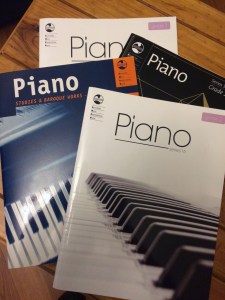 The first point above makes the combination of issues somewhat specific to Australia, as the Australian Music Examination Board (AMEB) is the dominant player in providing instrumental assessments in Australia only, but the problem of less available practise time and younger beginners is lamented by teachers worldwide, whether in relation to exams or just general progress.
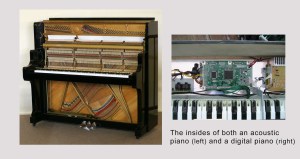 As good as digital pianos have become in simulating the sound and feel of an acoustic piano, there is nothing that can totally match the real thing. The majority of electronic instruments lack the tone and touch of an acoustic piano, as well as the feel and the ability to convey subtle emotion and feeling. An acoustic piano has strings and hammers, while a digital piano has none. Having actual strings means that there are thousands of things in an acoustic piano (such as sympathetically vibrating strings) that are difficult to reproduce convincingly on a digital piano.
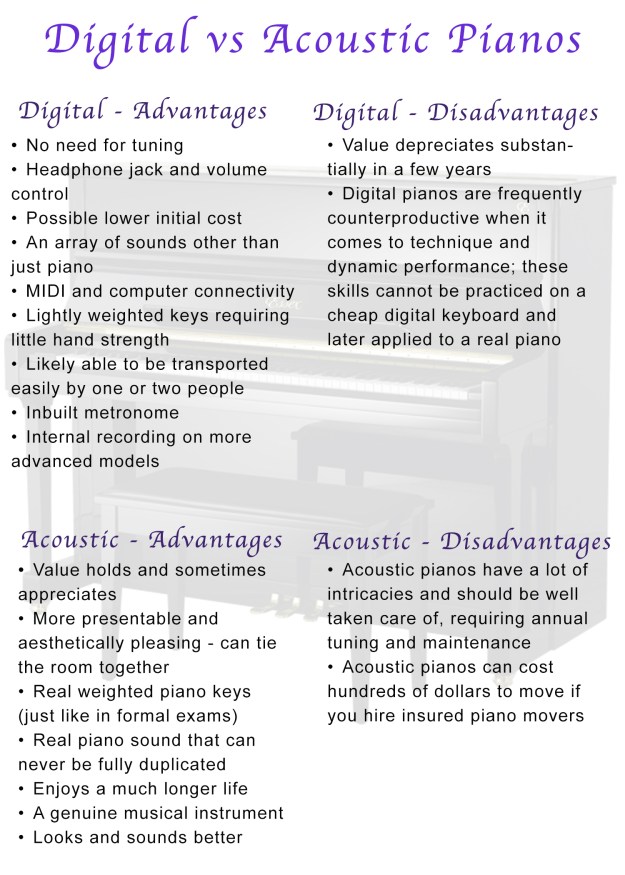 Whichever way you go, if the piano is incapable of delivering a good response to touch, the student will not improve.


 In mid-June, an assortment of students from our little piano studio in Wallsend sat for practical exams with Australia’s premier examining body, AMEB (Australian Music Examinations Board).
 Don’t slack off on your practise and then cram it all in during the week before.


 4. Encourage them to really listen to what they are doing… and listen yourself. If they play a section a few times and it changes from halting to fluent, congratulate and encourage them. Ask them what they are trying to achieve.
 merri bell music