Resources… resources… resources!!
Games, worksheets, iPad apps, flashcards…
The world of piano teaching has changed a great deal since the days I learned. These days kids seem to need more enticing and encouragement to learn. Perhaps this is because many of them are starting with piano at a much younger age. It may also be related to today’s kids being used to more instant results. Couple those reasons with the fact that the internet makes it much easier for teachers to share with each other their techniques and resources and the teaching world is awash with resource options.

Sifting through them all can result in some interesting finds. One that I found early on – but didn’t then understand all the benefits of – is the ladybird (or ladybug, depending on where you are in the world) squeeze toy. Used mainly as a tool to explain and encourage correct hand position, it also has a host of other uses.
When a younger (under 10) student starts with me, they receive their very own ladybird. They name it (a favourite seems to be Lily) and use it every day in their practise routine.
As mentioned, the main selling point of the ladybird is to show correct hand position at the piano. The shape of the bug mimics the natural position of the hands if you let them fall by your sides, which is also the optimum position for playing the piano. Having this visual as well as something that allows them to physically feel the shape is of great benefit to those who struggle to hold their hand correctly.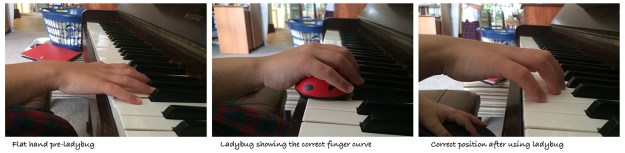
The other main use of the bug in my studio is to help build strength in the fingers. This is achieved simply by using the ladybird as you would a stress ball and regularly squeezing it – slowly and steadily. This is usually why the kids are using their ladybird every day – to help build strength in their little fingers that are suddenly being asked to do a whole new set of tasks. As the strength builds, flexibility also grows.
This regular use allows them to really connect with their bug and also allows them to have something of theirs with them in their ‘practise nest’ at practise time. Using it away from the piano (for squeezing) shows the kids right from the start that playing the piano isn’t just about the physical act of connecting fingers to keys, but incorporates their mind and their muscles and can be worked on in various ways even when a piano isn’t around.
As their playing develops, the ladybird can also be used for reinforcement of other techniques (e.g. placing it on the back of their hand and seeing whether it stays there or tips off according to the style they are being asked to play) so it can continue to grow with them as they develop.
I keep my eyes open all the time for new tools and resources, because you never know when you might come across something that seems simple, but can be of great benefit.
If you are considering music lessons for your child or for yourself, please contact me to discuss the options. Piano lessons are conducted at my studio in Wallsend, NSW.
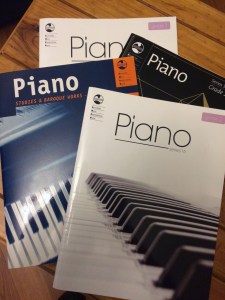 The first point above makes the combination of issues somewhat specific to Australia, as the Australian Music Examination Board (AMEB) is the dominant player in providing instrumental assessments in Australia only, but the problem of less available practise time and younger beginners is lamented by teachers worldwide, whether in relation to exams or just general progress.
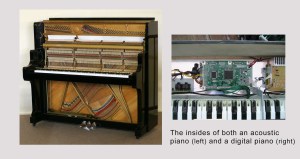 As good as digital pianos have become in simulating the sound and feel of an acoustic piano, there is nothing that can totally match the real thing. The majority of electronic instruments lack the tone and touch of an acoustic piano, as well as the feel and the ability to convey subtle emotion and feeling. An acoustic piano has strings and hammers, while a digital piano has none. Having actual strings means that there are thousands of things in an acoustic piano (such as sympathetically vibrating strings) that are difficult to reproduce convincingly on a digital piano.
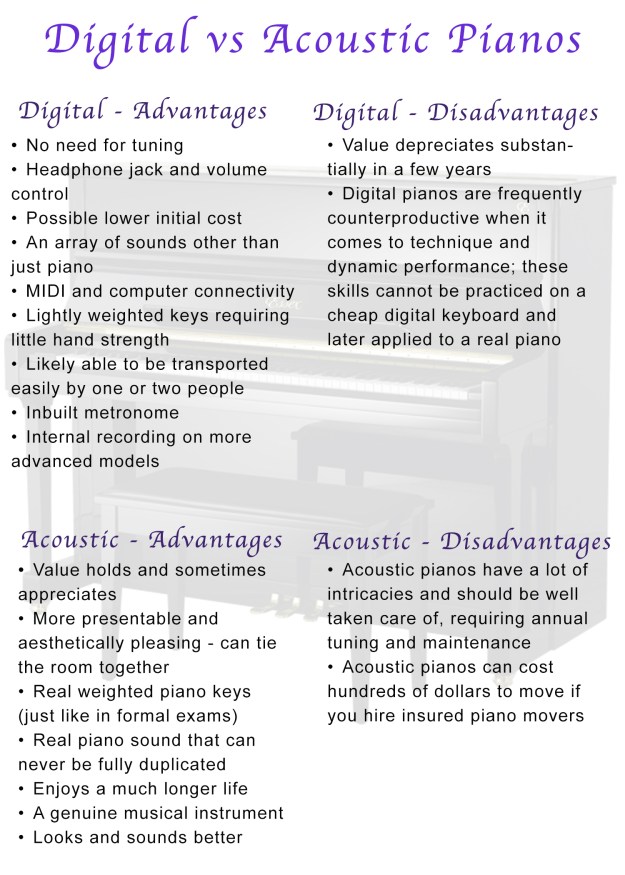 Whichever way you go, if the piano is incapable of delivering a good response to touch, the student will not improve.


 In mid-June, an assortment of students from our little piano studio in Wallsend sat for practical exams with Australia’s premier examining body, AMEB (Australian Music Examinations Board).
 Don’t slack off on your practise and then cram it all in during the week before.