The street on which I lived as a child was on a moderate hill – not overly steep, but enough that you certainly knew you were walking up a hill. Our street fitted in with another to form a circle, so there were always two different ways to get home. The most direct way involved walking up the hill. The less direct way meant walking up more of the hill (in the other direction) and then turning and walking downhill for a while to reach the house. This was a bit of a no-brainer when walking, but riding a bike was a different story.
Which way to go? The shorter hill, right? Nope! Not for me. I needed to finish on that downhill run. I would choose to have a longer uphill ride just so I had that wonderful, free feeling of flying downhill at the end. As a bonus, I didn’t reach home tired and out of breath.

Yummy dinner and vegetables. When you’re a child, those two things rarely go together. But we have to eat our veggies. So what do we do? My mother used to tell the story of being shut in the bathroom until she ate her peas. She would pop them one by one down the floor drain. At other times she would hide them under her mashed potatoes and on a really good night, she would manage to slide the potatoes (with hidden peas) onto her brother’s plate. The mashed potato story stayed with me and I quickly learnt that if I ate my veggies first – if I was lucky, covered with potato or gravy – then I could enjoy the rest of the meal without the vegetable concern hanging over my head. I still eat my veggies first.
So what does this have to do with playing the piano? More specifically, practising the piano?
The peak-end rule states that our evaluation of past experiences tend to be based on their most intense point (best or worst), and how they end. In a 1993 study, Nobel laureate Daniel Kahneman and colleagues asked a group of people to place their hands in uncomfortably cold water, but in two slightly different conditions. In one condition they had to keep their hand submerged in 14°C water for 60 seconds (which is not exactly comfortable). In another condition they were asked to place their hand in 14°C water for 60 seconds, but then leave it there for an additional 30 seconds while the temperature was gradually raised to 15°C. While 15°C is still unpleasant , is noticeably less painful than 14°C.
Given a choice, you would expect most people would choose the 60 seconds of pain rather than 60 seconds of pain + 30 more seconds of slightly reduced pain, right? But no. When given a choice of which trial to repeat, 69% of the participants chose to repeat the longer one – apparently perceiving that experience to be better overall, because of how the ending altered their perspective. Like riding up a longer hill just to experience the downhill run at the end.
 We can use this philosophy to make piano practise less of a chore and make it easier to get ourselves to practise again. Save the best for last. Have a piece that you enjoy playing sitting on the piano ready for you to turn to once the more challenging parts of practise are over. Or finish practise with the piece that requires the least work. Set yourself up so that you end practise on a positive note and you will feel much more inclined to practise again the next day.
If you are considering music lessons for your child or for yourself, please contact me to discuss the options. Piano lessons are conducted at my studio in Wallsend, NSW.

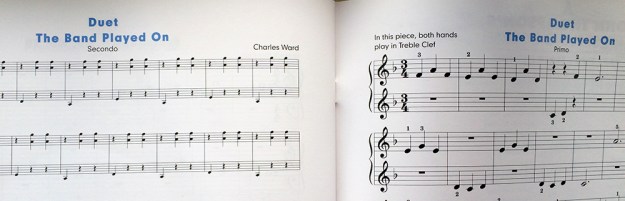 I still enjoy the fullness of sound a duet provides and regularly play a duet ‘together with myself’, where I record the Secondo (bottom part) on my digital piano and then play it back while I play the Primo (top part). Duets are certainly a special experience :-)

 Blob Chorus by Lumpty Learning is one such app, which introduces students to basic pitch recognition in a fun way. It is used in thousands of schools around the world because it also works well in a group setting, but its simplicity means it is also totally suitable for individual lessons.
 Although the game always opens with the default of three blobs, you can set the game to as little as two (which is the best place to start). As you improve, you can increase the number of blobs in the choir. The maximum is eight blobs, which is very difficult.
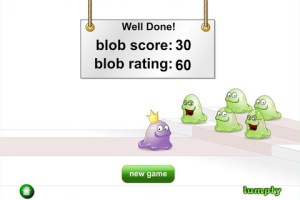 The game is separated into groups of ten questions; after each set of ten you will receive a score and an overall rating.
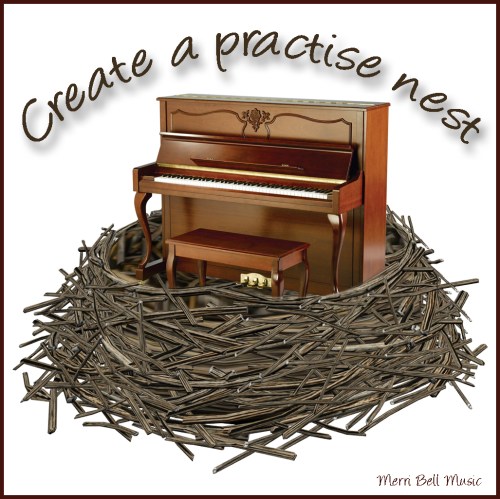 1. When choosing a location for your piano, select a space that is lived-in, welcoming, and well-lit. Keep it close to ‘the action’ but not in the action. Your children will gravitate to the piano more often if it is in a central place in your home. Avoid bedrooms, basements and other ‘put away’ places. Feeling shut-off from the family while practising will inevitably lead to a reluctance to spend time on the piano.
 However, for those who are going to be away from their piano for a period of time, standard practising obviously isn’t possible. I have
 The two I use most are the first two, as they are great early ear training activities asking only to tell the difference between two things. Is the note played a high note or a low note and are the notes going up or down? The interface is easy… just tap the red circle to hear the sound and then drag the same circle to either Beethoven Bear or Mozart Mouse, depending on your answer. For example, the image on the right shows the ‘Notes Going Up or Down’ activity. The student taps the red circle and hears a succession of notes. If they think the melody is moving from lower to higher notes, they drag the circle up to Mozart Mouse sitting at the top of the staircase. If the think the melody is moving downwards, they drag the circle to Beethoven Bear.
 The app also has a simple rhythm exercise, using the note values that are commonly learnt in their first few lessons. Beethoven Bear and Mozart Mouse are each standing under a different rhythm. The student taps the red circle to hear a rhythm and then drags the note to the character standing under the rhythm they think is correct. Once again, the question needs to be answered correctly before moving on.
 The middle pedal:
 merri bell music