
When we learn to read, we don’t begin with War and Peace, or the works of Shakespeare. We begin with learning letters and sounds, then blending those letters, then short words, then rules. It is a process. Learning music is no different. Simply learning what key on the piano is what note name doesn’t mean you can immediately play a Bach fugue. It is a process.
Scales are part of this process; they are the backbone of most music we play. They are the foundation of chords. They help to build muscle memory and dexterity. They are so important! Yet they are the hardest thing to convince students to practise.
Practising scales is crucial for piano students for several reasons, each contributing to both technical development and musical understanding. Here are the main reasons:
- Develops Finger Strength and Dexterity: Scales help build strength and agility in the fingers, which is essential for playing more complex pieces. Regular practise ensures smooth, controlled movements and coordination between hands.
- Improves Hand Coordination: Scales allow students to practise both hands together in various patterns, improving hand coordination and independence. This is important for playing pieces that require different actions from each hand.
- Enhances Technique and Control: Practising scales with proper fingering and hand positioning teaches good technical habits, which translate to better control over dynamics, articulation, and phrasing in more challenging music.
- Develops Knowledge of Key Signatures: Scales help familiarise students with all major and minor key signatures, improving their ability to recognise and understand the structure of different keys. This knowledge is essential for reading music and playing in various tonalities.
- Aids Sight-Reading: By regularly practising scales, students become more comfortable with the patterns found in music, which helps improve sight-reading skills. They will be able to recognise intervals, patterns, and harmonic structures faster.
- Improves Musical Ear: Playing scales helps develop a better sense of pitch and tonal relationships, improving the student’s ability to recognise intervals, chords, and melodies by ear.
- Builds Speed and Accuracy: Practising scales at various tempos allows students to gradually increase their speed and play more accurately, which is essential for performing more advanced repertoire.
- Develops Mental Focus and Discipline: Scales require focused and repetitive practice, fostering discipline and a deep connection to the music. Regular scale practise also trains the mind to maintain attention to detail and to practice with intention.
- Establishes a Foundation for Technique in Complex Pieces: Scales are the building blocks for more complex piano techniques like arpeggios, chords, and runs. Mastery of scales gives students a solid foundation for tackling more advanced technical challenges.
- Teaches Musical Phrasing and Dynamics: When practising scales, students can experiment with different dynamics, articulations, and phrasing, which will help them incorporate expressive elements into their playing in a more sophisticated way.

If you are considering music lessons for your child or for yourself, please contact me to discuss the options. Piano lessons are conducted at my studio in Wallsend, NSW.


 There are various benefits for singing during piano lessons:
 It is certainly more difficult to encourage students to sing than it is to get them to play, as singing seems to involve displaying a little more of ourselves, but it is this inner emotion we are trying to release. This is what we need in our playing. Once the students open up and let go, understanding how the music feels, they can really put some energy and feeling into what they’re playing.
 Athletes warm up before a game. They train with lots of repetitious drills so their body learns those actions and they can incorporate them into their game. Dancers work through lots of exercises to develop their physical skill. They also warm up before they dance. This is accepted as normal. Playing the piano incorporates a large portion of physical skill. It requires a strong technical foundation. Trying to play pieces of increasing difficulty without gradually building the physical skills required is like running a marathon because you understand the mechanics of running but haven’t trained. The result will be frustration.
 This is a no-brainer and has been covered in many previous blog posts. Lessons are generally as short as 30 minutes, and are when new concepts and material are taught, not where practise happens. Those concepts then need to be consolidated with practise at home, or at the next lesson you will still be in exactly the same place you were the week before. Practise is about feeling accomplished; setting a goal (even a small one) and achieving it.
 Having your piano in an out-of-the-way location. Having your piano or keyboard tucked away in a spare room or an area of the house not regularly accessed doesn’t encourage regular practise. Out of sight, out of mind! Have your piano in a prominent position in the house so it acts as a constant reminder.
 4. Encourage them to really listen to what they are doing… and listen yourself. If they play a section a few times and it changes from halting to fluent, congratulate and encourage them. Ask them what they are trying to achieve.
 Blob Chorus by Lumpty Learning is one such app, which introduces students to basic pitch recognition in a fun way. It is used in thousands of schools around the world because it also works well in a group setting, but its simplicity means it is also totally suitable for individual lessons.
 Although the game always opens with the default of three blobs, you can set the game to as little as two (which is the best place to start). As you improve, you can increase the number of blobs in the choir. The maximum is eight blobs, which is very difficult.
 The game is separated into groups of ten questions; after each set of ten you will receive a score and an overall rating.
 Always starting from the beginning. If you start a piece at the beginning every time you play it, you will find you quickly become proficient at the start of the piece but less so as the piece goes on. I often tell my students to start at the part they find the most difficult, work on that part and then incorporate it back into the song.
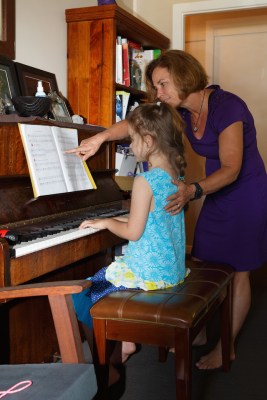 In this first part of a two-part post, we will look at some of the ways you can help your child that don’t involve the music itself. Part two (in two weeks) might surprise you with the ways in which you can be involved with the content of their practise.
 6. Ensure they are sitting correctly at the piano. Keep an eye on them and if you see them slouching, suggest they hold their back straight. This will not only stop body fatigue but will also help them balance their arms and hands properly. Their teacher should also be able to show you how they should be holding their hands, so you can keep an eye on that as well.
 One little girl sometimes asks for them to watch as she plays and she arranges them either on the music stand, or on top of the piano, and then performs for them. They bring her confidence.
 merri bell music