Tag Archives: piano lessons

What is Involved in Learning the Piano? – Piano Teacher in Wallsend, NSW

It’s a question – and the variants – that is asked quite often… what is involved in learning the piano? What is the commitment? How do we approach the early weeks and months? What will happen? So let’s have a look at what is required for a solid start.

These days there is an increasing trend to treat learning the piano the same way as any other extracurricular activity. On the surface, it’s another activity that ticks the educational box and it is “the done thing”. However, learning an instrument and particularly the piano, is a big commitment, even for the pupils who are just doing it for a bit of fun on the side. In fact, if piano is not practised regularly, pupils usually give up pretty quickly.

The reason for this is simple. Learning an instrument requires the use of three different types of memory:

  • visual;
  • auditory; and
  • kinetic (muscle/movement memory).

Piano lessons Wallsend NSWThe three must all be activated for a child to remember how a specific piece of music works. If a pupil doesn’t play or rarely plays during the week (for instance, just once at the weekend), the kinetic memory will not work and the student will not remember what to do. This usually results in them feeling discouraged. Chances are the lesson will be virtually the same as the previous one, the child will be disappointed and a vicious circle begins. A study determined that a pupil will forget 80% of the piano lesson if he/she does not practise within the following 48 hours. This is consistent with all types of research on learning and memory. A pupil who does not practise daily will not only feel bad, but will not play well at all and get frustrated. Think about how educators map out core lessons at school. In maths for example, if a child learned their times tables just on Monday morning they would struggle to remember them if they aren’t reinforced. Maths lessons are spread out throughout the week for a reason.

As you can see, practising regularly at home is crucial for the child’s enjoyment. It is absolutely necessary because a weekly half hour lesson will never be enough for them to make progress.

On the flip side of this is the good news… you don’t need to practise a lot if you practise every day. For a beginner, 5-10 minutes is fine. Of course this will increase with time, but it’s a good start and gets them into the habit. Children usually respond well to a routine so think about a fixed time such as just before dinner or straight after school. A little bit of patience and dedication is all it takes to both do well and get a real joy from their musical abilities.
Piano teacher Wallsend NSWThere are so many benefits to learning to play an instrument, but they aren’t all going to happen overnight. Because of this, it is not really appropriate to take the, “we’ll try it for a few months and see how it goes” approach. The commitment needs to be made for at least a couple of years. It’s about being realistic about what it takes to gain musical skills.

Besides, you have made a substantial investment in not only time, but tuition fees, music and possibly even an instrument. You want it to be worth it!

It is important to follow your child’s progress and help them to have a bit of fun and focus during their practise sessions. Most teachers write notes on the music and/or provide a practise sheet, so check them out and use those notes as a starting point. I have written a number of blog posts about making practise fun, using different incentives and mixing it up a bit and you can check them out by checking out past blog posts.

Finally, make sure your child brings their piano books to every lesson. While most teachers will have books that can be used during the lesson, no individual notes can be written in them and sent home with the child so the continuity is interrupted and the child will start their next practise session trying to remember what they were told.

Nobody wants piano practise to be a battlefield, so start out as you mean to carry on and establish the routine early. Then everybody can enjoy it.

If you are considering music lessons for your child or for yourself, please contact me to discuss the options. Piano lessons are conducted at my studio in Wallsend, NSW.
Ending Those Piano Practise Wars – Piano Teacher in Wallsend, NSW

I have an old cassette tape that is one of my most treasured possessions. My Dad made it for me many years ago and it contains different performances of mine over the years. It starts way back when I was 4 years old and made up a song (called “Baa, Little Lamb”) on the ukulele and also contains many snippets of me during piano practise. Or to be more precise, me arguing with either Dad or Mum about my piano practise. And all through my practise. I enjoyed playing and I did well, but like every other kid in existence, I didn’t like being told to practise. My sister and I knew that we had to practise twice a day; it was the first thing we did after breakfast and the first thing we did when we arrived home from school. Summer afternoons were hard. So were weekends. We had very strict parents. But we still tried it on.

So, as a teacher, I get it. I know my students don’t like to practise. But I also understand how much they need to. Playing an instrument is a physical skill and requires training of the muscles and fine-motor skills. When parents sign their child up for piano lessons they are not looking for a way to encourage epic battles at home.

How do we bring the desired peace to the home practise world? The wonderful folks at Teach Piano Today have put together five tips (with which I totally agree) to help restore harmony in your household.

Piano Teacher Wallsend NSW

1. LOCATION, LOCATION, LOCATION

It’s true in the real estate world, and it’s also true in the home practise world.  Having your piano in the most advantageous place in your home is of vital importance for successful home practise.

You want to find a balance between shoving the piano in a downstairs corner versus putting it in the centre of your most-used room.  Ideally the piano should be located in a comfortable room, close to where the family is, but away from major distractions.  Your child does not want to feel isolated during practise time – but they also do not want to compete with your food processor and washing machine.

2.  CRAMMING IS NOT THE ANSWER

Nothing stresses a parent out more than helping their child practise when they have 10 minutes before leaving for the piano lesson.  Keep the peace at home by beginning home practise immediately after you return home from their piano lesson.  This is the best time as they will still remember what they covered in their lesson, and the piano books will actually make it to the piano, setting you up for a good start to a week of practise.

Cramming creates feelings of inadequacy in your child as they struggle to perfect what should take 7 days to percolate.  Cramming makes you sweat and wonder why in the world you are paying for these lessons.  Cramming is not the answer.

3.  MISTAKES ARE OKAY

I promise!  It’s the job of your child’s teacher to sort out the mistakes in lesson time. Your job at home is to be the support – to remind them to spend time on the piano, congratulate them on their efforts, revel in the joy that is your child creating music, and show that you value music in your home.

Avoid the following statements and watch peace fall over your home immediately:  “Is that right?  I don’t think that’s right.”… “That’s not how it’s supposed to sound.”… “Are you watching your music?”… “Your sister played that piece and it didn’t sound like that.” … “Wrong note!”… “Try it again.” etc.  Your child will get their back up immediately and the practice wars are sure to ensue.

4.  “BUT MRS JONES SAID!”

How many times has your child shouted a statement similar to this?  “Mrs Jones said I only have to play the first page!”… “Mrs Jones said to play it up here.”… “Mrs Jones said to play it this fast!”… What your child is actually trying to say is “I want to be in charge of my learning.”  So let them.  Whether or not Mrs Jones actually said these things is beside the point.

Resist the urge to argue (and resist the urge to call up Mrs Jones to ask what the heck she is teaching) and trust that your child will sort it out themselves.  This is often a knee-jerk reaction on your child’s part – they so desperately want to be right and in charge and it’s their way of saying “Stay out of this, I’ve got it.”  If you allow them this right to direct their own learning you will help to create a confident piano student.

5.  BE PRESENT

For those parents who do sit with their child during practise sessions, you and your child will enjoy practise time so much more if you, the parent, are not multi-tasking.  Children thrive on one-on-one quality time,  and if this is combined with their piano practise, it is an activity that you will both grow to cherish.

Take away the distractions – the mobile ‘phone, the baby, the dog, the dinner preparation – and focus on just your child.  Soak up the experience of watching your young one learn such a complex skill.  Find a time to practise that isn’t restricted by deadlines.  Just enjoy making music together.  It’s difficult to start a practise war if you are truly “bonding on the bench”.

Piano practise is a commitment. It’s a daily event that can either be gloriously wonderful or horribly stressful.  Keep these five tips in mind when you start out this new practise week and welcome peaceful piano practise into your home with open arms.

If you are considering music lessons for your child or for yourself, please contact me to discuss the options. Piano lessons are conducted at my studio in Wallsend, NSW.

The 10 Worst Things to Do Before Your Piano Exam – Piano Teacher in Wallsend, NSW

Exam season is approaching and for many, it will be your first time experiencing a piano exam. Twelve months of work (or longer for Preliminary students) are culminating in this moment, giving you an opportunity to showcase everything you have learnt and practised.

The AMEB (Australian Music Examinations Board) have put together a list of ten things you should avoid before an exam. You can read the full article here but in summary the points are:

  1. Piano Teacher in Wallsend NSWDon’t slack off on your practise and then cram it all in during the week before.

  2. Use your nerves to create nervous energy that can heighten your performance.
  3. No stimulants – energy drinks, caffeine etc can have the opposite of the desired effect and can make you jittery.
  4. Don’t compare yourself to other candidates; all you can control is your own performance.
  5. Celebrate your hard work instead of downplaying its significance.
  6. Be sure of your general knowledge and practise your aural tests and sight reading well in advance of your exam date.
  7. Be outfitted classily and comfortably and in clothes that don’t restrict your movement.
  8. Have your closest supporters with you.
  9. Remember to show the examiner a beautifully musical performance (not just a display of technique).
  10. Do your best and be proud of it rather than stressing over your final grade.

Piano Teacher in Wallsend NSW

For most people, exams are a stressful time. The best thing you can do is know that you are walking in there as prepared as you can possibly be. If you know you have put in the necessary work, you should be able to enjoy – or at least appreciate – the experience through the haze of nerves.

If you are considering music lessons for your child or for yourself, please contact me to discuss the options. Piano lessons are conducted at my studio in Wallsend, NSW.


Distractions, Distractions… How to Banish Them With a Great Plan – Piano Teacher in Wallsend, NSW

“Hmmm… I really should go and make that cake I was thinking about yesterday…” 

“ I wonder if I could add a PowerPoint presentation to my history assignment…”

“I forgot to schedule the doctor’s appointment…”

“Oops… I can tell I should clean out the kitty litter…”

It’s great that our minds work so well to remind us of the things we need to be doing. It’s not so great that they tend to remind us at times when we should be concentrating on something else! Having your to-do list constantly jumping into your head when you’re trying your best to concentrate on practising the piano is far from ideal. You really need to be focusing on what you’re doing.

Piano Teacher in Wallsend NSW


Our brains have limited cognitive resources and we can’t be completely productive and engaged if we have baking and assignments on the brain. So what can you do to stop this happening?

Be clear about your intention before you start. Have a plan.


Researchers at Florida State University hypothesized that developing an “implementation intention” – a plan of how, where and when a project would be completed – would help to wipe other thoughts from the mind and make it easier to focus on the task at hand.

After studying 73 students in three different groups (a “plan” group, a “no plan” group and a control group) in a variety of situations, they concluded that the group who had planned their tasks before distractions were thrown at them not only performed better at their tasks, but also remembered more about the distractions. Because they were clear in their minds about what their plan entailed, distractions didn’t bother them as much and their minds were clearer.

However, simply brainstorming your plan doesn’t suffice; the plan needs to be specific. You also need to commit to the plan; the intention to follow through needs to be a big part of the deal.

Piano Teacher in Wallsend NSW

So where does piano practise fit in with this philosophy? If you sit down at the piano with the simple intention to practise, chances are your mind will be distracted by all the other things you should be doing… cooking, homework, cleaning etc. Instead, decide on a plan of what you intend to achieve for that session. Your teacher may have given you notes at the previous lesson outlining the areas that need work and this is a good place to start. Pick a passage that needs work, or a technique that requires improvement and decide what result you would like. For example, you may need to work on your two-note slurs and your plan could be to play five times an exercise you have been given by your teacher, then transfer that improved skill to your piece and play it three times. Or you may need to work on a list of scales; your plan could be to play each scale until you can play it three times in a row without error. Whatever you know needs work.

Basically:

  • Think about what you need to do;
  • Make a plan that is achievable;
  • Define the parameters of the plan; and
  • Commit to your intention to carry out the plan.

I’m sure you will find your practise sessions more productive and that’s a bonus for everybody!

If you are considering music lessons for your child or for yourself, please contact me to discuss the options. Piano lessons are conducted at my studio in Wallsend, NSW.

App Review “ScaleBlitzer” by BlitzBooks – Piano Teacher in Wallsend, NSW

I was a kid who, when it came time to study for school exams, would always pick maths first. Not because I was particularly good at maths or that it was my favourite subject (it certainly wasn’t). But to me it was about right or wrong. I had the answer right, or I had the answer wrong, so I knew how I was going. Maths had structure, order and logic and working my way through a list of problems was easy discipline.

Playing scales is, to me, a very similar discipline. You have a list of them and work your way through the list. If you play with the correct fingering you should end up finishing in the right place. OK, that’s probably a bit of a simplistic way of looking at it, but you get the point. Structure, order and logic. The things that suit my brain so well.

Piano Teacher Wallsend NSWI have posted before about how important scales are and why we play both them and arpeggios, but I am very aware that not everybody finds them quite as mesmerising as I do. Sometimes you need to kick things up a level. Add a bit of variety. That’s where the app “ScaleBlitzer” comes into the routine. I use this occasionally during lessons, but also encourage my students to use it regularly at home.

Enter all of the scales you have been given into your homework list and the app will generate a vast range of activities based on those scales. Basically, it throws them back at you in a random order, with added instructions. Mixing it up a bit. ScaleBlitzer remembers your homework and keeps track of your progress.

Piano Teacher Wallsend NSW

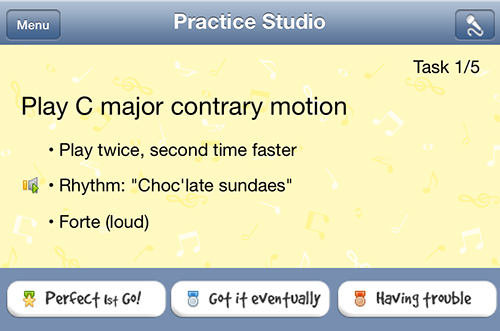
Once you enter the Practice Studio, there are five different modes from which to choose:

  1. Warm-up: Easy practice methods like ‘ascending only’, ‘play twice’, or ‘no blowing, fingering only’.
  2. Basic: No practice method given, just straight out no-frills instructions (e.g. like you would get in an exam).
  3. Muscle Builder: Practice methods using such things as rhythms and accents.
  4. Brain Strain: Harder practice methods, or a combination of two methods (e.g. in a certain rhythm AND staccato).
  5. Thrill Seeker: This mode will give you either really tough methods, or sometimes three different methods to incorporate into one scale.

The following is just a sample of the type of direction you may read:

  • Play twice, second time faster
  • Double staccato
  • Descending then ascending
  • Rhythm: “Seventy sixty fifty”
  • Play three times without stopping
  • Play twice, mezzo forte first time, piano second time
  • Accent: “Galloping galloping”

Piano Teacher in Wallsend NSW

One of the features that makes using this app interesting is the self-rating feature. After each scale, you need to select how you think you went – Perfect 1st go, Got it eventually or Having trouble – before moving on to the next one. As we know, effective practise requires listening to the way you’ve played something and deciding whether it needs more work or not. This self-rating system encourages listening and critical thinking, rather than just playing through.

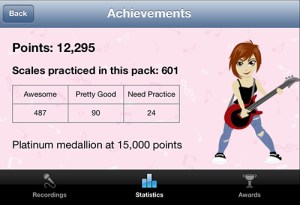
The app remembers what you do well and where you have trouble and future sessions are based on where the work is needed. You will be tested more often on the ones you’re having trouble with, until they start to improve.

Along the way, points are accumulated and characters and outfits are chosen and changed. Once you have made it through a Practice Studio session (5 scales/activities), it will offer you the opportunity to go on a World Tour, where you can choose your character, outfit and the countries in which you will play. The kids love getting to this part and it’s lovely to see their inner rock-child or pop princess come to the fore in their outfit choices! You can even record your playing to show your teacher what you have been doing.

Piano Teacher Wallsend

Overall, the aim is to make technical work more interesting to play while having a bit of fun along the way. I like using it as a teaching tool because it makes my students stop and think about what they are playing. For students, your technique will be improving without you being bored. For parents, it’s a bonus to have any resource that makes the kids want to play instead of having to nag them. You will also know they are practising the scales that need the most attention, because ScaleBlitzer is keeping track of it. At the end of the day, improved technical work means improved technique, which results in improved playing. If we can add in a bit of fun and variety along the way, then we have a bonus!

If you are considering music lessons for your child or for yourself, please contact me to discuss the options. Piano lessons are conducted at my studio in Wallsend, NSW.

Does Your Child Have a Secret Weapon? – Piano Teacher in Wallsend, NSW

Young pianists who are successful usually have one thing in common… great parents!

As we start a new term, it’s a good time to take a peek into the world of the piano parent and how much their involvement and attitude can shape their child’s journey. Trevor from Teach Piano Today  has written a great article explaining this, so there’s no point me trying to rehash it.

Piano Teacher in Wallsend NSW

I will say though that I had a learning experience very similar to his and it made all the difference in the world. My parents didn’t let my sister and I quit as soon as we felt either too challenged or bored (because both things will happen at different times), they were involved in our practise sessions and they certainly made piano a priority. We always knew it was a commitment.

Have a read through Trevor’s words here and see if you are being a secret weapon in your child’s success.

If you are considering music lessons for your child or for yourself, please contact me to discuss the options. Piano lessons are conducted at my studio in Wallsend, NSW.

Getting Through the Holidays – Piano Teacher in Wallsend, NSW

Let’s make this school holiday period about the word ‘more‘.

MoreWithout being restricted by the kids’ school routine, you probably have more time. What does this mean for piano practise?
Don’t break the practise routine you have running through term, but use this opportunity to have more fun with practise.

Become more involved.

Create more interaction.

Understand more about what your kids are playing.

How do you do this? By asking them questions. Ask them about what they are playing. Ask them to show you how to do something. For my students, I can supply some flashcards you can use. Following are some examples/suggestions to get you started:

  • What part of this piece do you find the hardest? Can you play just that part for me?
  • Can you play a scale with your eyes closed?
  • Can you show me how to play the last note and then nod at me when it’s time to play it?
  • Can you play this piece in slow motion?
  • Can you follow me conducting you? (Vary the speed and have them follow you).
  • What story do you think this piece is telling?
  • Can you pick one bar and clap the rhythm? I’ll try to copy you.
  • Can you explain to me what this means? (Pointing to any marking on the music).

It doesn’t matter if you don’t know the answers. It is all about getting them to think about what they are doing and sharing it with you. They will love being able to teach you something!

If there is something they can’t answer, have them make a note to ask their teacher, but don’t dwell on it; move on to something else. You want to keep it interactive and fun.

Throw a different question at them every time they practise and you might be surprised how eager they are to share with you. Have fun with it 🙂

If you are considering music lessons for your child or for yourself, please contact me to discuss the options. Piano lessons are conducted at my studio in Wallsend, NSW.

App Review “Magic Piano” by Smule – Piano Teacher in Wallsend, NSW

Piano teacher in Wallsend NSWIt may seem odd that I have selected an app that isn’t about learning the fundamentals like note recognition, timing or pitch. There is no keyboard and there are no note names.

But music education apps don’t need to be always obviously teaching. This app has been around for a few years now and I love it for its more subtle advantages:

  • Encourages eye-hand co-ordination;
  • Develops fine motor skills;
  • Exposes students to a range of music they may not otherwise hear; and
  • Helps students to develop a good sense of rhythm.

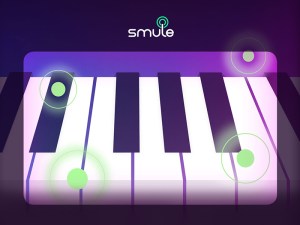
Piano teacher in Wallsend NSWThe basic premise is that balls of light – representing the notes of a song – drop down the screen towards a line. You need to tap these balls as they reach the line. Doing so in the correct combination and sequence will play the song correctly. The balls are spaced variably and need to be tapped in the correct location, so you aren’t passively staying in one place.
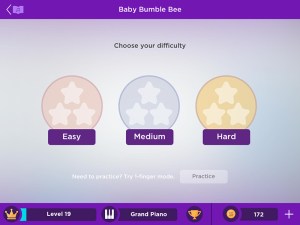
The app is free and you are started off with a handful of free songs. Additional songs can be purchased for “smoola” (the in-game currency), which can be purchased or earned. Also, most days a free song is offered. You can earn smoola by watching advertising videos. I have never paid real money for smoola and have still accumulated over 165 songs, so it is easy enough to keep the game free and have enough content to keep you occupied.

Piano teacher in Wallsend NSWThree different levels of difficulty are available for every song – easy, medium and hard. The easy level contains single notes and two-note chords. The medium level includes three-note chords while the hard level moves up to four-note chords. There is also a range of difficulty in the songs themselves. For example, many of the old traditional pieces are written basically and are therefore simple, while a classical piece is much more involved. This means it is still incredibly useful (and fun) for total beginners but challenging for experienced musicians.

You can try playing with one hand or two. Being used to coordinating my hands from years of playing, I prefer to use two hands in faster passages when swapping quickly between chords and single notes.

Some songs link in with Smule’s other apps (singing and guitar) so you can play along to somebody else singing the song. You can even share your performance on social media.

Having a large range of music styles available means kids – and even adults – are exposed to styles of music they might otherwise never hear. This is a great asset for overall musicality and always a benefit for a music student. There are lots of current chart-toppers as well as favourites, such as songs from Frozen. The styles included are:

Pop Rock Country
Classical J-pop & K-pop Kids’ songs
Traditional Video games Movies & TV
Musicals

A little added extra (that I don’t use, so usually forget about) is a virtual keyboard that can be used to play tunes. It comes in a few different configurations. The tone is good, but the keys are very narrow.

Like any app, it’s not perfect and there are two aspects that are not ideal. Sometimes the balls drop too quickly after periods of rest or longer notes, so keeping to the rhythm you know is correct in your mind will result in you seeing a “play faster” message. This only happens occasionally on slower songs. A young friend once showed me that she could still get a perfect score by very quickly tapping on every ball, even though she wasn’t playing the notes of a chord together or following the correct rhythm. It was disappointing that doing this could result in a perfect score. But if you want to use it properly, it is a great tool.

Remember that not everything educational needs to be shouting it from the rooftop. Sometimes the more subtle approach can have just as much benefit. But be warned… this one is a little addictive!

If you are considering music lessons for your child or for yourself, please contact me to discuss the options. Piano lessons are conducted at my studio in Wallsend, NSW.

How to Practise When You’re Not Really Practising Part II – Piano Teacher in Wallsend, NSW

It’s likely that nowhere in the world does there exist a child who loves to practise. It’s just not how they are made. As adults, we can understand the reasoning behind the philosophy and appreciate the resulting improvement, but for kids it is a necessary evil… a drag.

So while we want them to learn to appreciate it, it doesn’t mean we can’t occasionally throw some fun in there for them as well. Chances are they won’t even realising they are practising!

If you find your child’s interest is waning or you’re just tired of the battle, give some of the following ideas a go:

  • Piano teacher in Wallsend NSWHave them pick one of their pieces and turn all of the notes into twins. i.e. play every note twice.
  • Roll dice to determine what bars of their piece to play. If they are playing pieces more than a couple of lines long, also add the value of the dice. For example, if they roll a 3 and a 6, they should play bars 3, 6 and 9. Keep playing just these bars until they can play them from memory.
  • Get into rockstar mode… stand up to play and have them strike their best rockstar pose.
  • Have an adult conduct them at varying speeds. If the adult waves their baton (whatever you can find in your kitchen, or even a piece of paper rolled up) fast, the child should play fast. Slow down the conducting and the playing should slow down as well.
  • Piano teacher in Wallsend NSWPlay only the first note in each bar. Write out this new melody.
  • Have the child make a paper aeroplane and throw/fly it towards the piano. Wherever the plane lands is the octave in which they should start playing their piece. If they miss the keyboard, they have to play the piece normally… three times!

Adding some fun and variety into some of their practise sessions will hopefully keep practise fresh for your child (and less stressful for you). Plus, a less mundane practise is much more likely to be effective and beneficial. See what other ideas you can come up with 🙂

If you are considering music lessons for your child or for yourself, please contact me to discuss the options. Piano lessons are conducted at my studio in Wallsend, NSW.

Keeping Your Body in Tune – Piano Teacher in Wallsend, NSW

Today I am having an operation on my shoulder. It is a subacromial decompression (or acromioplasty) to relieve the impingement that has caused me pain and greatly restricted movement for the past twelve months. When I first visited the physiotherapist he was not the least surprised to hear I was a pianist and piano teacher. He said shoulder injuries are not uncommon in our profession. So that started me thinking about how as creatives, we often don’t adequately look after the physical side of things.

Back up straight, feet flat on the floor, arms at right angles, hands high, fingers curved. We have all heard those instructions many times. Good teachers will establish correct posture at the first lesson and will continue to reinforce it. But we tend to think this is solely for better technique and ease of playing and forget that it also serves to protect our bodies.

Playing the piano is not just a mind-finger-piano activity. It is an holistic experience that incorporates our whole body (along with our mind, spirit and emotions), so we need to look after our body not only to harmonise all these aspects but also to compensate for the hours we spend sitting at our instrument.

As musicians, we use a vast array of muscles to play an instrument, but rarely are we encouraged to exercise these muscles. Hundreds of muscles in our body work together to help achieve the nice tone we produce. The reasons why our arms, hands and fingers are important are the most obvious, but we also rely on other areas. For example, our hips affect how we sit and need to move freely to support our torso as we reach up and down the keyboard.

In not considering the physical strain we are placing on our bodies, we instead tend to abuse them. We lean forward, hunching our shoulders, to peer at the music (particularly when concentrating on a troublesome passage), which causes the back to ache and places undue pressure on the shoulders. We sit in the one place for too long without moving, or we sit incorrectly, creating problems in the back, hips and thighs. The tension of concentrating can create stiffness in the wrists and hands.

Piano teacher in Wallsend NSW

So what do we do about this? We need to be aware of the quality of our movement. Are our movements tense or free? Awkward or smooth? Are we at the keyboard in a position where our muscles and ligaments are working for us or working against us? We can train for a better quality of movement by training attention and awareness.

Stretching and exercise are vitally important. Just as an athlete stretches and prepares before and after exercises, so should musicians before and after playing. Significantly, stretching can prevent injury. However, it also helps to strengthen the muscles and if done regularly, can also slightly lengthen them, which leads to them becoming more efficient. Long hours of practise can also cause tension in the muscles, which stretching will help to release.

Muscles that work better are more effectively prepared to perform, so by stretching and exercising, you can more quickly develop skills and move forward. The new-found balance you feel will inevitably reflect in the quality of your performance.

Tara Davidson from All Better Bodies is a stretch specialist and a massage therapist, so she understands the body and how keeping it in top physical shape can affect all areas of our lives. This includes being supple and flexible in the areas that are affected by and used to play the piano.

Stretch classes are run by Tara twice a week in Toronto, NSW; Tuesday mornings (9.15-10.00am) and Thursday nights (6.15-7.15pm). Be sure to ‘like’ her page – All Better Bodies – for more information and ongoing help with health, fitness and nutrition.

Tara has devised and recorded a short stretching routine that is great for any pianist to run through before sitting down at the piano. Give it a try!

If you are considering music lessons for your child or for yourself, please contact me to discuss the options. Piano lessons are conducted at my studio in Wallsend, NSW.