Tag Archives: piano teacher Newcastle NSW

Playing vs Practising… A How-to Guide – Piano Teacher in Wallsend, NSW

“Every difficulty slurred over will be a ghost to disturb your repose later on.”           
Frédéric Chopin (18101849) Polish Composer and Pianist

Practising the piano and playing the piano are two different things. If a student plays through all their pieces each day they may well find at the end of the week there is no discernable improvement, even though they have spent hours at the piano.

So what is the difference between playing and practising? Playing is just that – playing the piece through over and over and hoping it improves. Practise involves breaking down the song and working on each weak area as a stand-alone section.

The phrase I probably use most often with my students is, “slow it down” as that is always the first approach to a troublesome section. When you slow down you can better pinpoint where the problem is. It can be difficult to do when you know how the piece sounds; your brain will push you to speed it up and it is easy to lose concentration, but the benefits are worth the effort.
Piano teacher in Wallsend NSW

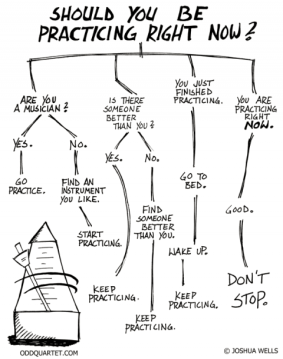
A tongue-in-cheek view of practising

Isolate the problem area and separate the hands, playing each hand on its own until you are more confident with the part each hand is playing. Really think about what you are asking your hands and fingers to do. If there is a run or passage that follows the pattern of a scale or arpeggio, it can help to play that technical exercise a few times first. Then slowly put the two hands back together and work to gradually increase your pace.

While slowing down and/or separating hands, still aim to maintain all the expression (dynamics, tempo etc) required.

Once you feel better about that section, put it back into the whole piece and see how it sounds and feels. If it is improved, move on to the next problem section and go through the same process. Using this method, you will eventually play the piece fluently and with pride in what you have achieved.

If you are considering music lessons for your child or for yourself, please contact me to discuss the options. Piano lessons are conducted at my studio in Wallsend, NSW or mobile lessons are available in the eastern suburbs of Lake Macquarie.

Scales… Pain or Gain? – Piano Teacher in Wallsend, NSW

Ah, scales. A word that causes many musicians to sigh with exasperation or boredom. Personally, I always welcomed them, with their structure and consistency. Love them or hate them, scales are a big part of practise life for any musician (instrumentalist or vocalist).

A scale is “…any set of musical notes ordered by fundamental frequency or pitch. A scale ordered by increasing pitch is an ascending scale, while descending scales are ordered by decreasing pitch.” (Wikipedia) They are the backbone of all types of music we play.

While a variety of scale types exist, each type is defined by its characteristic interval pattern. It is the constant repetition of these patterns that causes scales to be such a large part of learning to play an instrument – including the voice – because they help build muscle memory. By playing scales, your fingers will learn to easily go to the correct notes in the scale you are playing, so when you play a piece of music, your fingers will move more automatically to the correct notes.

Piano teacher Wallsend NSWWhy practice scales?

  1. Scale practice plays an essential part in developing a pianist’s skills.
  2. They improve keyboard fluency.
  3. Scales develop posture, hand position and coordination, as well as balance between the hands and movement of the arm.
  4. Practising scales speeds up the learning of new pieces (muscle memory).
  5. They develop evenness of line and quality of tone.
  6. Scale playing builds aural awareness.

For students preparing for an exam, the examiner will be looking for:

  • A positive sense of rhythm without under-accentuation;
  • Even, firm tone and a musical curve;
  • Good legato;
  • Accurate and fluent realisation of the different types of scales, arpeggios and broken chords; and
  • Convincing negotiation of technical challenges such as smooth passage of thumb and hand coordination.

So the lesson here is we need to learn to love scales. They are incredibly beneficial physically and the basis of all we do as musicians. All practise sessions should start with a variety of scales, even if their only purpose is to warm up the fingers and hands (although we know they do much more than that). To break up the repetitive nature of practising scales every day, apps such as Blitz Book’s ‘Scale Blitzer’ can add a bit of fun.

If you are considering music lessons for your child or for yourself, please contact me to discuss the options. Piano lessons are conducted at my studio in Wallsend, NSW or mobile lessons are available in the eastern suburbs of Lake Macquarie.

What Are Piano Lessons For? (Piano Teacher in Wallsend, NSW)

The contemporary Australian composer, Elissa Milne, has written a lovely article on the purpose of piano lessons. When an article has been written with so much knowledge, insight and passion, there is no point in trying to express it any differently so please take the time to read through her thoughts.

Elissa writes about a range of benefits, from learning to “do cool stuff on the piano”, understanding others and yourself and changing who you are, through to the sheer joy of it.

Enjoy “What Are Piano Lessons For?” by Elissa Milne

If you are considering music lessons for your child or for yourself, please contact me to discuss the options. Piano lessons are conducted at my studio in Wallsend, NSW or mobile lessons are available in the eastern suburbs of Lake Macquarie.