
Ah, scales. A word that causes many musicians to sigh with exasperation or boredom. Personally, I always welcomed them, with their structure and consistency. Love them or hate them, scales are a big part of practise life for any musician (instrumentalist or vocalist).
A scale is “…any set of musical notes ordered by fundamental frequency or pitch. A scale ordered by increasing pitch is an ascending scale, while descending scales are ordered by decreasing pitch.” (Wikipedia) They are the backbone of all types of music we play.
While a variety of scale types exist, each type is defined by its characteristic interval pattern. It is the constant repetition of these patterns that causes scales to be such a large part of learning to play an instrument – including the voice – because they help build muscle memory. By playing scales, your fingers will learn to easily go to the correct notes in the scale you are playing, so when you play a piece of music, your fingers will move more automatically to the correct notes.
 Why practice scales?
- Scale practice plays an essential part in developing a pianist’s skills.
- They improve keyboard fluency.
- Scales develop posture, hand position and coordination, as well as balance between the hands and movement of the arm.
- Practising scales speeds up the learning of new pieces (muscle memory).
- They develop evenness of line and quality of tone.
- Scale playing builds aural awareness.
For students preparing for an exam, the examiner will be looking for:
- A positive sense of rhythm without under-accentuation;
- Even, firm tone and a musical curve;
- Good legato;
- Accurate and fluent realisation of the different types of scales, arpeggios and broken chords; and
- Convincing negotiation of technical challenges such as smooth passage of thumb and hand coordination.
So the lesson here is we need to learn to love scales. They are incredibly beneficial physically and the basis of all we do as musicians. All practise sessions should start with a variety of scales, even if their only purpose is to warm up the fingers and hands (although we know they do much more than that). To break up the repetitive nature of practising scales every day, apps such as Blitz Book’s ‘Scale Blitzer’ can add a bit of fun.
If you are considering music lessons for your child or for yourself, please contact me to discuss the options. Piano lessons are conducted at my studio in Wallsend, NSW or mobile lessons are available in the eastern suburbs of Lake Macquarie.

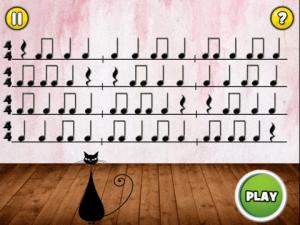 Rhythm Cat teaches and reinforces the most commonly-used musical rhythm notation. The free ‘Lite’ version has 15 levels while the ‘Pro’ version works up to following three different colours in each rhythm, encouraging co-ordination of both hands.
 The ‘Cat’ family also includes ‘Treble Cat’ and ‘Bass Cat’. I don’t tend to use Bass Cat with my beginners because it starts in a different octave, but Treble Cat is better suited. These games involve recognising the notes from amongst a group of notes, not just on their own. The notes also move slowly, giving you plenty of time to recognise the correct notes.
 A basic note recognition app, NoteWorks is customisable for difficulty, including clef/s and range of notes. The interface and sound effects are fun for younger students, but the app still moves quickly enough to be challenging for older students and adults.


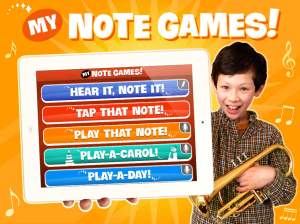 Tap that Note uses the device to identify notes, while Play that Note requires you to play to specified note on the piano (or whatever instrument you tell the app you are using). Play-a-day is a great sight reading exercise for intermediate students. As the name suggests, Hear It, Note It – also available as a standalone game – involves listening to what is played and notating it and has three difficulty levels within. Activities include tasks such as adding accidentals to correct a scale or completing rhythms with notes, rests and bar lines.
 While it does contain basic note recognition, Tenuto is really suited to more advanced students, as the majority of activities are more complex.

 In our late teens to early adulthood, these differences became our strengths. We worked together really well because we complemented each other and didn’t suffer from competition. Even when we sang, I sang the soprano to her alto. When she moved on to singing lessons, I accompanied all her practising. The picture on the right is a famous artwork that was on the cover of a card she once gave me.

 While most previous studies had used only strongly-emotive music, this study had participants bring in music they preferred. This ranged from classical music through to techno, country, film soundtracks and heavy metal. The participants were then studied using MRI while listening to 60 different excerpts of new music, based on their musical taste. They also had the option to ‘buy’ a song in a mock online store, based on the 30-second samples.
 Let them write on their music (in pencil, of course). While you don’t want them writing in every single note name, marking up spots where they are having trouble every time may help. It might be the note names of a tricky passage or an unusual timing count that trips them up. Having a little help written in may increase their confidence with the whole piece.
 merri bell music