
Today I am revisiting an old post (with some additions), because it has become even more relevant lately.
Scales. Love them or hate them, scales are a big part of practise life for any musician (instrumentalist or vocalist). Arpeggios, broken chords and other technical exercises are also vital, but they build on scales, so scales are where we start this conversation.
It’s difficult to convince kids to play scales. I understand this (although I have always loved their structure and consistency) but refusing to practise technical work only hinders progress. The benefits for technique, style, rhythm, tone and aural awareness are all listed below, but there is also a big reason that relates to more recreational music…
 Chords! All the popular music that kids like to play revolves around chords. Chords are based on scales. If the scales flow freely from your fingers and the construction is understood, chords can come easily. Improvise with chords – with or without a melody line – and you can follow a lead sheet and play a vast range of songs.
Scales are the backbone of all types of music we play and each one of the variety of styles is defined by its characteristic interval pattern. It is the constant repetition of these patterns that causes scales to be such a large part of learning to play an instrument – including the voice – because they help build muscle memory. By playing scales, your fingers will learn to easily go to the correct notes in the scale you are playing, so when you play a piece of music, your fingers will move more automatically to the correct notes.
 Why practice scales?
- Scale practice plays an essential part in developing a pianist’s skills.
- They improve keyboard fluency.
- Scales develop posture, hand position and coordination, as well as balance between the hands and movement of the arm.
- Practising scales speeds up the learning of new pieces (muscle memory).
- They develop evenness of line and quality of tone.
- Scale playing builds aural awareness.
For students preparing for an exam, the examiner will be looking for:
- A positive sense of rhythm without under-accentuation;
- Even, firm tone and a musical curve;
- Good legato;
- Accurate and fluent realisation of the different types of scales, arpeggios and broken chords; and
- Convincing negotiation of technical challenges such as smooth passage of thumb and hand coordination.
So the lesson here is, whether for technique or pleasure, we need to learn to love scales. They are incredibly beneficial physically and the basis of all we do as musicians. All practise sessions should start with a variety of scales, even if their only purpose is to warm up the fingers and hands (although we know they do much more than that). To break up the repetitive nature of practising scales every day, apps such as Blitz Book’s ‘Scale Blitzer’ can add a bit of fun and variety.
If you are considering music lessons for your child or for yourself, please contact me to discuss the options. Piano lessons are conducted at my studio in Wallsend, NSW.

 You understand the mechanics of running, but does the information in your brain translate to your muscles so they know how to behave? No. The muscles need to learn those new skills.
 A similar problem occurs when – for a variety of reasons – students want to rush through levels of exams. This often means learning only the minimum number of pieces to get through, and the overall musicianship is sacrificed.
 Don’t slack off on your practise and then cram it all in during the week before. Playing piano is a (cumulative) physical skill as well as mental; you wouldn’t run a marathon if you had only been training for a week.
 Not just between your child and their instrument, but also between your child and music in general. There have been lots of studies proving the benefits of music to our brains, but these benefits won’t occur by just turning up to a 30-minute lesson once a week. They will also learn more about their instrument – how it feels, how it sounds, what it can do – and will become more attuned to how they can control what sound it can produce.
 To play an instrument, your child’s brain is processing a great number of details simultaneously, combining rhythm, pitch, technique, body positioning, fine motor skills, dynamics, texture, tonal shading and more. The synapses being developed in the brain of a musician are unique.
 Piano skills don’t instantly appear, but grow over time. Having a goal towards which they can steadily progress gives your child the opportunity to understand the concept of steady progress and delayed gratification.
 When they play sport, they accept they will have to go to training sessions. Many of them probably practise their ball skills at home. But they don’t call it practise.
 These days there are coaches for everything – fitness coaches, vocal coaches, sport coaches, diet coaches, life coaches, drama coaches, executive coaches, dance coaches. The list goes on and on.
 Try it out with your kids. Change the language. See if they are happier to rehearse or to train or even to prepare for their next coaching session. Modify the vocabulary and find what works for them. Whether we like it or not, neglecting practise – or not practising enough – is not going to get them anywhere. But perhaps rehearsing or training will.
 The Most Addicting Sheep Game is a seemingly simple rhythm app for the iPad where jumps and rolls must be perfectly timed to the music by tapping or swiping on the screen. It is easy to learn, but tricky to master.
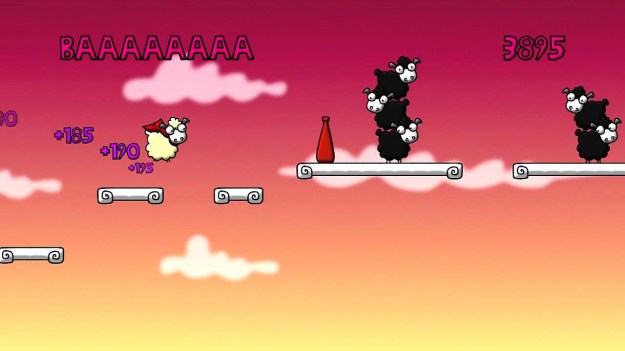 The sheep can jump at either one, two or four beats and can also jump two different height levels. An obstacle on the path – such as a tower of balancing sheep – requires a swipe to knock down. This means, as with most things to do with playing music, your brain is concentrating on multiple things at the same time. The picture above shows one beat and two beat lengths, a double jump and single jumps plus swipes. All of that would take less than five seconds to execute. Plus it all has to be done strictly in time with the music!
 The graphics are cute and the music is catchy. At first the music can be annoying – especially when you aren’t being successful – but all of a sudden you will find it’s an integral part of the mood and the fun.
 You can find it


 merri bell music