Tag Archives: Wallsend NSW

Gifted and Talented: Dangerous Labels – Piano Teacher in Wallsend, NSW

Over the years I have attempted a number of different instruments, with a variety of results. Some, like the guitar, came to me fairly easily. But reed instruments are my Waterloo. I can’t even get a decent sound from one. Does this mean I am hopeless and never destined to play a reed instrument because I don’t have a natural gift? Not at all.

Prowess doesn’t result solely from being naturally talented or having a gift. Success is a result of hard work. In the music field, this equates to time and effort (I’m avoiding that nasty p word…).

Piano lessons Wallsend NSW

Australian musician and educator, Samantha Coates, has written a great article – here – on how these words are often misunderstood in a practical application. “Hard work can trump ‘giftedness’ most of the time.” Let me know what you think in the comments section below.

If you are considering music lessons for your child or for yourself, please contact me to discuss the options. Piano lessons are conducted at my studio in Wallsend, NSW.

Encouraging More Practise – Piano Teacher in Wallsend, NSW

As we start another year after a lengthy Summer break, I thought it was a good time to revisit an old post about ways you can help your kids to advance with the piano by practising effectively.

Establishing a practising routine can be hard work! Playing the piano is not easy and your kids will try all sorts of excuses to get out of practising. It is important to set practise time into their general routine so it has a place and is not just something that is done if they have leftover time.

Following are some tips to encourage more practise:

  • Never underestimate a reward system. Use whatever works for your child; it could be anything from extra iPad time to an exemption from a household chore. Their reward may even be a favourite meal.
  • Schedule practise time to happen before something they can relax with – free play time, for example. Of course, if you suspect this may lead them to rush through practise with no concentration, try another tactic.
  • Give your child something exciting to work for. Anticipation works wonders. Set a practise goal, wrap a little gift and pop it somewhere they can see it. Only when they reach the practise goal are they able to open their gift.
  • Connect their practise session with another activity that occurs every day. Perhaps your child could practise straight after breakfast or maybe before they start their homework. Whatever works for you.
  • Remember to reward yourself. This is your journey as well, so find something fun with which to reward yourself when you are successful at getting your kids to practise. Or maybe even something you could do together.

Piano Teacher Wallsend Newcastle NSW


A great little resource for practising tips for parents is the e-book “101 Piano Practice Tips”, which is available through Amazon.


If you are considering music lessons for your child or for yourself, please contact me to discuss the options. Piano lessons are conducted at my studio in Wallsend, NSW.

Staying in Shape (On Your Piano) Over Summer – Piano Teacher in Wallsend, NSW

Here in Australia, the school holiday break over Christmas is a long one. Six weeks to enjoy the warmth of Summer with lots of outdoor and fun activities.

But six weeks is an awfully long time to go without practising. Kids usually assume if they stop practising for a while, when they restart they will be able to pick up where they left off, but this is not the case. They will quickly realise they have gone backwards.

So what can you do to keep your playing in shape during such a long period of no lessons and no routine?

 1. Practise in the morning. If you are on break from school, choose a time in the morning for practising. This way, you know it will be done and you can then spend the rest of the day being able to say, ‘Yes!’ to any plans that may come your way. If you plan to practise later in the day, there is a very high likelihood that something else will come up and practise won’t happen.

Piano Teacher in Wallsend NSW2. Set a goal. No matter what your level, from beginner to advanced, you can benefit from setting some practise goals. You may want to learn a new song, memorise a piece or even improve your sight reading. Set interim goals for yourself along the way so you can check in and make sure you’re on track.

3. Practise sight reading. Sight reading is a skill that is invaluable. If you want to be able to jam with your friends, sight reading is of huge benefit. Do you want to be able to play ‘fun’ songs you hear on the radio? Sight reading lets you do this. You can also read music you like that is written for other instruments or find a friend and sight read duets. Make sight reading part of your practise sessions every day and you will soon see the benefits.

Piano Teacher in Wallsend NSW 4. Listen. While this won’t actually exercise your playing muscles, it is a very important part of learning and studying music. Listen to lots of different pianists and listen to other instruments as well. Children tend to only know the music styles listened to by their parents, so its a good opportunity for them to be exposed to a variety of genres. One of my students has grown up with the classic rock of her parents but has recently discovered musical theatre soundtracks (thanks, YouTube). She is enthralled with how the mood of the music tells a story and often comments on “the power” she hears in songs. Expose your musical ear to all sorts of things. You won’t like them all, but you will find plenty you do like.

5. Mental practise. If you are on a trip and won’t have access to your piano (or another one), upload some of the music you are working on to your phone, iPod, laptop, etc. Many of these pieces will be available on iTunes or you can have your teacher record them for you or find a (well-played) version on youTube. Take your sheet music along with you, too. If you are spending long hours in a car or on a plane, or spending several nights in a hotel, those are great opportunities to listen while following along to the music. You can also practise your fingering without having a piano; it is also a great opportunity to visualise how you want the music to sound.

6. Perform. Plan a little summer recital for your family and friends. Often the summer holidays are when people are more relaxed, on leave from work and have more free time. For many of the adults in your child’s life, it may be the only opportunity they get to hear your child play. If you are an adult pianist, when is the last time you played for somebody? Ask your friends to listen to you before you hang out. There is no such thing as too much playing in front of other people; it’s wonderful for building confidence and your listeners will also love it.Piano Teacher in Wallsend NSW

7. Have fun! When you’re working hard all year for exams or recitals, it’s often hard to find time to play other music. Summer is the perfect time to pull out the music you have always wanted to learn. Discover something new and learn how to play it, not for any reason other than you want to. Remember the joy.

If you are considering music lessons for your child or for yourself, please contact me to discuss the options. Piano lessons are conducted at my studio in Wallsend, NSW.

The Peak-End Rule and How it Makes Practising Less of a Chore – Piano Teacher in Wallsend, NSW

The street on which I lived as a child was on a moderate hill – not overly steep, but enough that you certainly knew you were walking up a hill. Our street fitted in with another to form a circle, so there were always two different ways to get home. The most direct way involved walking up the hill. The less direct way meant walking up more of the hill (in the other direction) and then turning and walking downhill for a while to reach the house. This was a bit of a no-brainer when walking, but riding a bike was a different story.

Which way to go? The shorter hill, right? Nope! Not for me. I needed to finish on that downhill run. I would choose to have a longer uphill ride just so I had that wonderful, free feeling of flying downhill at the end. As a bonus, I didn’t reach home tired and out of breath.

Piano Teacher in Wallsend NSW

Yummy dinner and vegetables. When you’re a child, those two things rarely go together. But we have to eat our veggies. So what do we do? My mother used to tell the story of being shut in the bathroom until she ate her peas. She would pop them one by one down the floor drain. At other times she would hide them under her mashed potatoes and on a really good night, she would manage to slide the potatoes (with hidden peas) onto her brother’s plate. The mashed potato story stayed with me and I quickly learnt that if I ate my veggies first – if I was lucky, covered with potato or gravy – then I could enjoy the rest of the meal without the vegetable concern hanging over my head. I still eat my veggies first.

So what does this have to do with playing the piano? More specifically, practising the piano?

The peak-end rule states that our evaluation of past experiences tend to be based on their most intense point (best or worst), and how they end. In a 1993 study, Nobel laureate Daniel Kahneman and colleagues asked a group of people to place their hands in uncomfortably cold water, but in two slightly different conditions. In one condition they had to keep their hand submerged in 14°C water for 60 seconds (which is not exactly comfortable). In another condition they were asked to place their hand in 14°C water for 60 seconds, but then leave it there for an additional 30 seconds while the temperature was gradually raised to 15°C. While 15°C is still unpleasant , is noticeably less painful than 14°C.

Given a choice, you would expect most people would choose the 60 seconds of pain rather than 60 seconds of pain + 30 more seconds of slightly reduced pain, right? But no. When given a choice of which trial to repeat, 69% of the participants chose to repeat the longer one – apparently perceiving that experience to be better overall, because of how the ending altered their perspective. Like riding up a longer hill just to experience the downhill run at the end.

Piano Teacher in Wallsend NSWWe can use this philosophy to make piano practise less of a chore and make it easier to get ourselves to practise again. Save the best for last. Have a piece that you enjoy playing sitting on the piano ready for you to turn to once the more challenging parts of practise are over. Or finish practise with the piece that requires the least work. Set yourself up so that you end practise on a positive note and you will feel much more inclined to practise again the next day.

If you are considering music lessons for your child or for yourself, please contact me to discuss the options. Piano lessons are conducted at my studio in Wallsend, NSW.

The Benefits of Duets – Piano Teacher in Wallsend, NSW

I was lucky when I was learning the piano – my sister was also learning. Plus my Mum played. That meant I always had a duet partner available. Duets certainly have their challenges, but most of my memories of playing duets involve lots of laughter. My only complaint at the time was I always had to play the bottom part, which was usually keeping the beat and not as melodically interesting. Nevertheless, duets formed a significant part of our performing, particularly in our teenage years and were always fun.

Piano teacher in Wallsend NSW

“Piano Duet” by Pamela Blaies (http://pamelablaies.com)

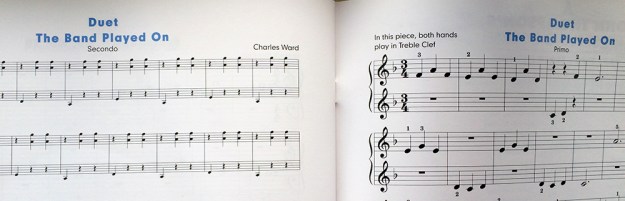
The method books I use to teach my beginners – and most method books on the market – have a teacher accompaniment that can be played along with the student. It not only ‘fills out’ the sound of their very basic piece for them and makes what they are playing sound much more impressive for them, but it also unknowingly begins to teach them the fundamentals of playing duets.

The benefits of playing piano duets are many and include:

  1. Developing listening skills – the only way your duet will be successful is if you are constantly listening to what the other person is playing to ensure you are staying together.
  2. Early accompanying skills – following on from developing listening skills, learning how to follow or catch-up to the other person can set up the quality skills of a good accompanist.
  3. Teaches good timing – good tempo needs to be kept by both parts or the piece won’t flow and will sound very disjointed. With a partner, you are more likely to maintain a steady pulse and keep going. Over time, you will gain more rhythmic constancy and learn to adapt to any tempo set by a partner.
  4. Teamwork and interaction – pianists usually spend a lot of time playing alone. Playing duets not only encourage interaction with others (as practising together is essential) but you also need to be working together as a team to ensure the piece flows beautifully.
  5.  Articulation and compromise – it’s not just about the correct notes and timing. Duet partners need to learn how to articulate their ideas for interpretation, and then learn to compromise these with the other person’s ideas. Duets teach students to listen carefully, ensuring the parts balance evenly and that articulation ideas passed between the two parts are precisely performed.
  6. Motivation and accountability – while the two players are working as a team, for kids playing duets, they usually want to make sure they don’t sound worse than their partner, so will try their hardest. If they don’t know their part, they may feel they are letting down their partner as they know both of them are accountable for the best result. This also encourages more focussed concentration.
  7. Increased confidence – for those students who are nervous about performing, having a performing buddy is often a much-needed confidence boost.
  8. Pedalling awareness – one person will be pedalling for the other, while the second person will be surrendering their pedal control. This needs to be negotiated and controlled.
  9. Duets are impressive –  audiences (particularly parents watching their children play a duet together) love duets; they sound full, rich and harmonious and watching two pianists play together in sync is entertaining.

Piano Teacher in Wallsend NSWI still enjoy the fullness of sound a duet provides and regularly play a duet ‘together with myself’, where I record the Secondo (bottom part) on my digital piano and then play it back while I play the Primo (top part). Duets are certainly a special experience :-)

If you are considering piano lessons for your child or for yourself, please contact me to discuss the options. Piano lessons are conducted at my studio in Wallsend, NSW.

How Pianists’ Brains are Different – Piano Teacher in Wallsend, NSW

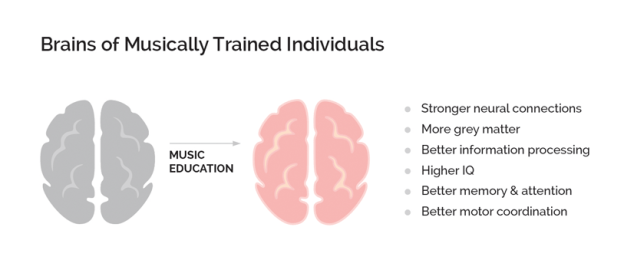
“Piano is the ultimate instrument in terms of skill and demand. Two hands have to play together simultaneously while navigating 88 keys. They can play up to 10 notes at a time. To manage all those options, pianists have to develop a totally unique brain capacity — one that has been revealed by science.”

Piano Teacher in Wallsend NSW

Image courtesy of The Piano Kitchen

“Because both hands are required to be equally active for pianists to master their instrument, they have to overcome something innate to almost every person: right or left-handedness.”

Continue reading this great short article by Jordan Taylor Sloan to find out how they do this and why pianists brains are different.

If you are considering music lessons for your child or for yourself, please contact me to discuss the options. Piano lessons are conducted at my studio in Wallsend, NSW.


Ladybird, Ladybird, Fly to My Hand – Piano Teacher in Wallsend, NSW

Resources… resources… resources!!

Games, worksheets, iPad apps, flashcards…

The world of piano teaching has changed a great deal since the days I learned. These days kids seem to need more enticing and encouragement to learn. Perhaps this is because many of them are starting with piano at a much younger age. It may also be related to today’s kids being used to more instant results. Couple those reasons with the fact that the internet makes it much easier for teachers to share with each other their techniques and resources and the teaching world is awash with resource options.

Piano Teacher in Wallsend NSW

Sifting through them all can result in some interesting finds. One that I found early on – but didn’t then understand all the benefits of – is the ladybird (or ladybug, depending on where you are in the world) squeeze toy. Used mainly as a tool to explain and encourage correct hand position, it also has a host of other uses.

When a younger (under 10) student starts with me, they receive their very own ladybird. They name it (a favourite seems to be Lily) and use it every day in their practise routine.

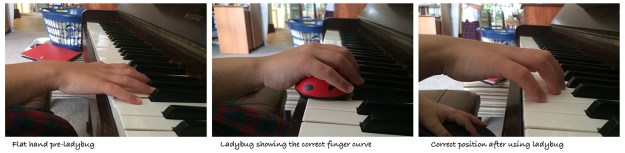
As mentioned, the main selling point of the ladybird is to show correct hand position at the piano. The shape of the bug mimics the natural position of the hands if you let them fall by your sides, which is also the optimum position for playing the piano. Having this visual as well as something that allows them to physically feel the shape is of great benefit to those who struggle to hold their hand correctly.Piano Teacher in Wallsend NSW

The other main use of the bug in my studio is to help build strength in the fingers. This is achieved simply by using the ladybird as you would a stress ball and regularly squeezing it – slowly and steadily. This is usually why the kids are using their ladybird every day – to help build strength in their little fingers that are suddenly being asked to do a whole new set of tasks. As the strength builds, flexibility also grows.

This regular use allows them to really connect with their bug and also allows them to have something of theirs with them in their ‘practise nest’ at practise time. Using it away from the piano (for squeezing) shows the kids right from the start that playing the piano isn’t just about the physical act of connecting fingers to keys, but incorporates their mind and their muscles and can be worked on in various ways even when a piano isn’t around.

As their playing develops, the ladybird can also be used for reinforcement of other techniques (e.g. placing it on the back of their hand and seeing whether it stays there or tips off according to the style they are being asked to play) so it can continue to grow with them as they develop.

I keep my eyes open all the time for new tools and resources, because you never know when you might come across something that seems simple, but can be of great benefit.

If you are considering music lessons for your child or for yourself, please contact me to discuss the options. Piano lessons are conducted at my studio in Wallsend, NSW.

App Review “Blob Chorus” by Lumpty Learning – Piano Teacher in Wallsend, NSW

Aural training – or developing ‘a good ear’ – is such an important part of becoming a musician. It helps with everything from being able to harmonise through to simply recognising if you’ve made a mistake. But not everybody is born with a naturally good ear and even those who are can still learn to better refine it.

So how do we help our students develop their aural skills without the drudgery of drills and exercises? We use fun apps!

Piano Teacher in Wallsend NSWBlob Chorus by Lumpty Learning is one such app, which introduces students to basic pitch recognition in a fun way. It is used in thousands of schools around the world because it also works well in a group setting, but its simplicity means it is also totally suitable for individual lessons.

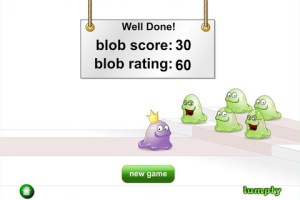
The premise of the game is simple: a number of green blobs have formed a choir and they are singing for King Blob (who is purple and wears a crown). Each blob sings a note and then King Blob sings a note. The note sung by the king is the same as a note sung by one of the blobs. But which one? This is what you need to identify.

Piano Teacher in Wallsend NSWAlthough the game always opens with the default of three blobs, you can set the game to as little as two (which is the best place to start). As you improve, you can increase the number of blobs in the choir. The maximum is eight blobs, which is very difficult.

If the incorrect blob is selected, that blob will explode, but you are able to select another blob and continue doing this until the correct blob is selected. At any time you can click the ‘hear blobs again’ button at the bottom to hear the remaining blobs sing their notes again.

Piano Teacher in Wallsend NSWThe game is separated into groups of ten questions; after each set of ten you will receive a score and an overall rating.

Free on the Apple app store (but not for Android), the Apple version can be found here.

If you don’t own or have access to an iPad or Android tablet, never fear! The game is also available in a web version here; it just requires an internet connection.

They not only look cute, but they sound really cute as well 🙂

If you are considering music lessons for your child or for yourself, please contact me to discuss the options. Piano lessons are conducted at my studio in Wallsend, NSW.

Going with the Flow – Piano Teacher in Wallsend, NSW

Young Mr G was resisting participating in a composing activity. I use a system that tells a cute little story and each lesson of the system builds on that story and subtly introduces another technique the students can use in their composition. Mr G liked the story and the idea behind it but he wasn’t going to try it out. No way. He procrastinated. He changed the subject. He fiddled with other things. So I let it go for that week and we smoothly moved on to something else.

The next week Mr G turned up with two plain books that he had made in school that day. He had folded in half many sheets of plain paper, with a different coloured sheet on the outside of each one. He had experienced trouble stapling the middle and wondered if I could help. We stapled up the books and I had an idea… I asked him what his plans were for the books (he had no specific plans) and asked if perhaps he would like to use one in his lesson to compose some rhythms. He was so thrilled to have a purpose for one of his treasured books, he jumped at the opportunity. He chose his red book and composed his rhythm. I drew a staff in the book, he put his rhythm to music and his motif was born. The first composing lesson was done! He was so proud of his achievement, he even let me video it to share with my Facebook page (and normally he is not a fan of sharing).

The moral of the story? Go with the flow. 

I work hard on creating curriculums and I have a plan mapped out for each student. It’s important to know where we’re heading, plus it provides them with structure and a goal. But it’s all pointless if they aren’t engaged and sometimes that engagement can come from the most unlikely of sources. As a teacher, I need to be constantly alert for teaching opportunities. It may mean the lesson plan is derailed, but as long as they are learning something valuable and at their level, then the things in the lesson plan can always be caught up later.

Miss G (sorry, but their names really do start with the same letter) is a young teen who loves to experiment on the piano and she plays a lot of songs with a chord base. She has worked out a lot of this herself and will often show me what she has been doing. I realised though that she is solely playing by ear (a great skill in itself) but without understanding why she was playing those particular notes. So all of a sudden the lesson changed and turned into a conversation about chord construction, major vs minor triads and typical chord progressions (and even 12-bar blues). I wanted her to have the knowledge to work out where she should go next without having to try every note until one sounded right. It was important to ‘derail’ because playing this other music is what fuels Miss G’s love of piano when the slog of scales and exam prep becomes a chore.

Of course, this is harder with the students who are on an exam trajectory. If they want to reach their goals by exam time, their time is fairly tightly scheduled and because most of them don’t practise very much these days, lesson time is often spent going over things that should have been conquered during home practise. But even within those confines, it is important to be adaptable. Go with the flow.

If you are considering music lessons for your child or for yourself, please contact me to discuss the options. Piano lessons are conducted at my studio in Wallsend, NSW.


Creating a Practise Nest – Piano Teacher in Wallsend, NSW

Would you sleep soundly if the only place you could sleep was in the middle of your laundry while the washing machine and dryer were operating?

How productive would your work be if half the items you needed to do that work were not to hand?

If you were trying to study, would your effort be effective if you were banished to a cold, musty downstairs room away from the warmth and comfort of the main house?

Of course, we are more successful in what we do if we have everything we need, are in the best environment and are nice and comfy. It’s no different for our piano practise. If going to the piano is lonely, uncomfortable and disorganised, chances are you (or your child) won’t feel inclined to practise. What can we do to help?

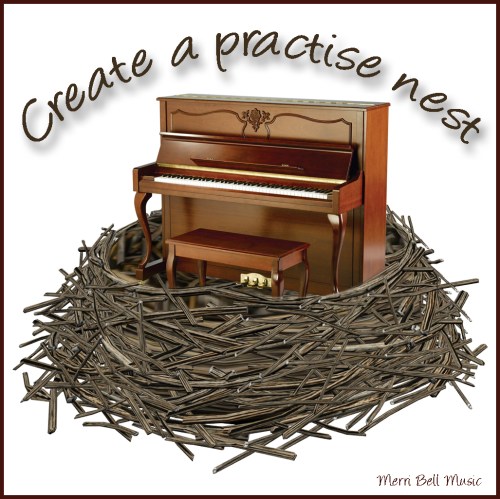
We can create a ‘practise nest’. A place that is welcoming, comfortable and organised.

The wonderful folk at Teach Piano Today have provided some great tips for creating such a space. While they have been written for parents of piano kids, the same tactics apply for adult students; create a nest where you feel comfortable and have everything you need before you begin.
Piano Teacher in Wallsend NSW1. When choosing a location for your piano, select a space that is lived-in, welcoming, and well-lit. Keep it close to ‘the action’ but not in the action. Your children will gravitate to the piano more often if it is in a central place in your home. Avoid bedrooms, basements and other ‘put away’ places. Feeling shut-off from the family while practising will inevitably lead to a reluctance to spend time on the piano.

While choosing an appropriate space, also consider the noise factor; not only from the piano, but also from your family’s day-to-day activities. Your children want to be close by, but not competing with noise from televisions, dishwashers and washing machines.

2. Make the space warm and welcoming. Your children will be encouraged to spend upwards of 30 minutes every day in this space. Is it a happy place to be for this amount of time? Small adjustments to lighting and heating can make a world of difference. Seek out places with natural light and ensure it is a cheerful and welcoming space that will encourage your child to visit the piano often for their own enjoyment.

3. Ensure your children have all required materials at hand. Help your children put together a small basket or bin of everything they may need for home practise. Pens, pencils, highlighters, and post-it notes will give your children a sense of organisation that will then spill over into their practise habits. Your children will also need adequate lighting to see their music, and a comfortable bench at the correct height to practise comfortably and correctly.

4. Make the practice nest a communal space.  Children of any age appreciate company while they practise. Having a chair, couch, beanbag chair or pillows nearby where family members will be inclined to sit, listen and enjoy the music immediately sets the tone for happy time on the piano. Encourage siblings to stop by and listen quietly, and allow yourself even just 10 minutes to sit and listen with undivided attention each time your children practise. A set-up that is conducive to including the family in home practise will encourage everyone involved to make piano practise an activity the entire family can be a part of.

5. Set the stage for organisation. Ensure your children’s practise space is uncluttered and organised. Clear out old sheet music and books from the piano bench, use a magazine organiser to hold current and favorite materials, and minimise knickknacks and other distractions from the top of the piano. If you can, avoid having the piano room do “double-duty” for laundry, toys and other clutter. Having the books your children need at their fingertips reliably ensures that no time is spent searching for lost or crumpled music. Get into the habit of placing the piano books in their appropriate space immediately after each piano lesson so they are ready and waiting.

Plus one more! Adding small surprises to your children’s practice nest (fresh flowers, a hand-written note of encouragement, a small treat, a new sticker pad, a special pen etc.) helps to show that you value the time they are spending on the piano and that you appreciate their efforts and dedication. Preserving the “specialness” of their practise space encourages positive feelings towards their home music time.

If you are considering music lessons for your child or for yourself, please contact me to discuss the options. Piano lessons are conducted at my studio in Wallsend, NSW.