Tag Archives: Wallsend NSW

Using Piano Pedals – Piano Teacher in Wallsend, NSW

When new students start with me, I always open up the piano and let them see the inside and how it works. Nearly without exception, the part that fascinates them the most is the mechanism for the pedals. They love to play with the pedals, as they can see and hear at the same time the differences depressing and releasing the pedals make.

The two or three pedals on your piano help make your playing dynamic and interesting, helping to provide tonal shading. However, there’s usually a fair bit to learn before the pedal can be introduced; you need to crawl before you can walk. By the time they get to use the pedal, students are usually pretty keen!

Correct use of the pedal involves placing your heel on the floor in front of the pedal so the ball of your foot rests comfortably on the pedal. Angling the ankle downwards should then depress the pedal, while bringing the ankle back up again (gently, or it will ‘clunk’) will release the pedal. Your heel should never leave the floor while pedalling as it is the pivot point. In the same way that playing the keys relies heavily on maintaining a loose, flexible wrist, playing the pedal relies on a flexible and comfortable ankle joint.

Composers use a few different ways to indicate when to depress the pedal, when to release it, and when to make a quick up-down pedal change. The picture below shows the different notations you will regularly see. A notch in the pedal line indicates a quick pedal change; lift your foot enough to allow the pedal to clear, and then quickly press the pedal down again.

Piano teacher in Wallsend NSW

Each instrument has its own pedal personality and you will learn the idiosyncrasies of your own over time, just as with the rest of the piano.

The right pedal:

The pedal used most often is the right pedal, called the sustain or damper pedal. It has two main functions:

  1. Allows the sound to continue after the keys are released.
  2. Bringing a deeper, richer and more resonant quality to the timbre of the sound.

One thing that pianists tend to overlook is that during the Classical period (the generation of Haydn, Mozart and Beethoven, or roughly from 1750 to 1820), the sustain pedal was a special effect. Therefore it should be used carefully when playing their music.

The left pedal:

The left pedal is called the una corda or soft pedal.

The main function of the soft pedal is to change the timbre of the sound, making it sound more distant. It can create a hushed atmosphere. Making the sound softer is of secondary importance – you should be able to play pianissimo (very softly) without it.

When the composer wants you to use the soft pedal, you see the indication una corda. Release it when you see the indication tre corda

Frank Hutchens’s ‘Two Little Birds’ requests at the beginning that both pedals (meaning right and left) are used simultaneously. The soft pedal gives the quiet atmosphere of the woodlands with the birds in the distance, while the sustain pedal provides the gentle, legato sound.

Piano Teacher in Wallsend NSWThe middle pedal:

This pedal has a different purpose depending on whether you are playing a grand piano or an upright.

  • On a traditional grand piano, the middle pedal is known as the sostenuto pedal. It acts as a damper for only the notes your fingers are playing as you depress the pedal. For example, if you  play a chord in the bass and then depress the sostenuto pedal, you can then play crisp, staccato notes in the treble but only the bass chord will remain sustained.
  • Older upright pianos didn’t normally have a third, middle pedal. For those uprights that do have three, the middle pedal is commonly known as the practice pedal. It mutes all the strings, allowing you to play as normal (including using the other two pedals) but softening the overall sound substantially. There is a notch to the left of the pedal so it can be locked in place. It is great for practising without disturbing your neighbours.

A good ‘pedalling instinct’ is based on knowledge, a very good hearing and mindful practice. This is why it is not used extensively with beginners. They need to develop an understanding of the music and how they play before introducing the pedal to enhance it.

The most important thing about pedalling is to not overuse it. It only takes a little overuse of the sustain pedal for everything to sound blurry. Always ask yourself how using the pedal is going to improve what you are playing.

If you are considering music lessons for your child or for yourself, please contact me to discuss the options. Piano lessons are conducted at my studio in Wallsend, NSW.

App Review – “The Most Addicting Sheep Game” by Just So – Piano Teacher in Wallsend, NSW

Run. Jump. Roll.

Jump… double jump… swipe….

Ping!  Boing!  Whoosh!

Piano Teacher in Wallsend NSW

The Most Addicting Sheep Game is a seemingly simple rhythm app for the iPad where jumps and rolls must be perfectly timed to the music by tapping or swiping on the screen. It is easy to learn, but tricky to master.

On the surface, the connection to traditional music education could be considered faint, as it does not involve written rhythm and connecting that to an aural beat, but it is still definitely all about rhythm. The rhythms are very precise – a fraction of a second off and your sheep will fall through the cracks – and the higher levels are very difficult, so I feel it definitely has its place as a music education app. It is aural, rather than theoretical.

The premise is that you control a sheep that jumps to the beat, either with a single finger tap, two-finger tap, or swipe. The aim is to work through all the increasingly difficult levels, while also scoring maximum points. Plus, it has cute sheep!

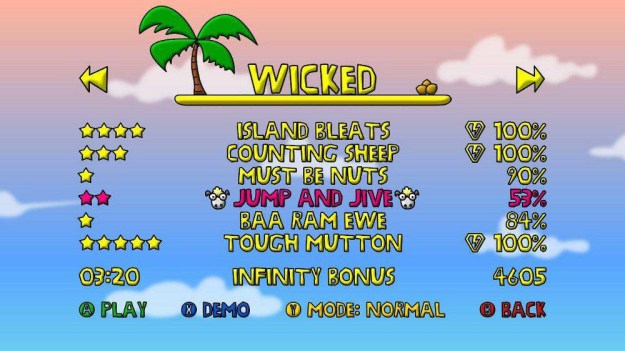
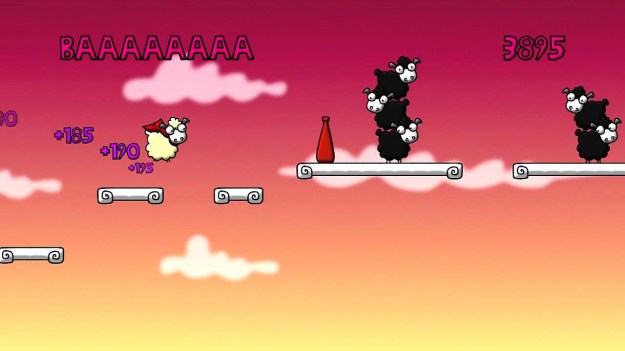
Piano Teacher in Wallsend NSWThe sheep can jump at either one, two or four beats and can also jump two different height levels. An obstacle on the path – such as a tower of balancing sheep – requires a swipe to knock down. This means, as with most things to do with playing music, your brain is concentrating on multiple things at the same time. The picture above shows one beat and two beat lengths, a double jump and single jumps plus swipes. All of that would take less than five seconds to execute. Plus it all has to be done strictly in time with the music!

Piano Teacher in Wallsend NSWThe graphics are cute and the music is catchy. At first the music can be annoying – especially when you aren’t being successful – but all of a sudden you will find it’s an integral part of the mood and the fun.

While you can get through to the end of a level by ignoring the height of the jump and always using two fingers, you will be penalised and won’t obtain the full score possible. If you’re anything like me and always want to see three stars at the end of a level, this just won’t do the trick.

The game begins with a Training mode, which has six different rounds within it. This mode teaches the basics of the single jump, double jump and swipe and then combines them all together. The levels after that are titled:

  1. Mild;
  2. Tricky;
  3. Wicked; and
  4. Grim.

Each of these levels contains six rounds. All levels, including training, also have an ‘infinity bonus’ level that doesn’t have the usual pre-determined ending, but will continue until you miss a jump and lose your sheep.Piano Teacher in Wallsend NSW

You can find it here in the Australian app store. It is not a free app, but costs only $1.29, a small cost for the amount of time it will keep you occupied.

If you are considering music lessons for your child or for yourself, please contact me to discuss the options. Piano lessons are conducted at my studio in Wallsend, NSW.
Why Do I Teach the Piano? – Piano Teacher in Wallsend, NSW

Why do I teach the piano? Why do I want to help others grow their love of music and gain the ability to do what they desire with that love? This is a long one, so you may want to make a cuppa and settle in for a read and a listen…

Piano teacher in Wallsend, NSW

My mother, Carole and her mother, Doris. Mum and Mama.

For me it is all about legacy. There has been a great legacy left to me by my mother and my grandmother, as well as other ancestors. I am honoured to have received from them my family’s musical gift. While I inherited very little else from them physically, I do have similar hands to theirs; obviously a pianist’s hands. I inherited their ear, which will pick out an alto harmony as quickly and easily as hearing the melody. And I inherited their accompanying skill.

As I have not been blessed with children of my own, I have had to look elsewhere for an outlet to share this treasure. Not only what I have inherited, but everything I learned along the way to help me put it all into practice. I want to help somebody else start their own family memories.

Growing up, music was a tremendously large part of my life. So much of our family life revolved around music. Much of this was also connected to our church, but music extended beyond that as well.

Our family was part of a large church of very musical people (most of whom were related to us somewhere down the line). It was quite common for the congregation to naturally break into four-part harmony during the hymns. Mum and Mama (my grandmother) shared the job of church organist, a role each of them held from their teenage years right up until they were no longer physically able to play. They also played for all weddings and funerals held at the church.

We had a reputation in the area for being a very musically-talented church and often hosted functions where music was shared with the wider public. The church was also well-known for putting on great stage productions and although the congregation was smaller by the time we were old enough to participate, we still carried on the tradition. Mama always provided the accompaniment. My sister and I even produced shows ourselves when we were older. My fondest memories of growing up with my sister are the times we spent together singing and playing duets.

Piano teacher in Wallsend, NSW

Singing in church on Christmas morning with Mum conducting us and Mama accompanying us.

When we were teenagers, Mum and Dad formed a teen singing group (called ‘Heritage’) and we performed around the region. Mum was the musical director and arranged all our songs while our accompanist was, yep you guessed it… my grandmother. She said we all kept her young!

I moved on to working musically in other areas, becoming involved with the local amateur theatre scene, including a few stints as a musical director. Once, when I had an absent band member, Mum jumped in at short notice and played a whole week of shows for me. Good accompanists are hard to find (it’s so much more than just being able to play) so in later years when Mum was the director of the local ladies’ choir, Nova Chorale and needed an accompanist, I helped her out for a couple of years.  She also accompanied half my HSC music class for their practical exam.

While I feel most musically aligned with my mother and grandmother, there are other musical influences in my life. My Dad was a wonderful violinist in his younger days, and still has a good ear and a lovely singing voice. He was always fully involved in all our musical endeavours and used to buy me little instruments (like a fife and a harmonica) on a whim so I could “give it a try”. Mama had brothers with beautiful voices and married a lovely tenor in my Grandad. Grandad used to sing to all the grandkids as he bounced us up and down on his crossed leg (Diddley-um words sung to the melody of ‘My Dreams Are Getting Better All the Time’ comes to mind).

Piano teacher in Wallsend, NSW

Second from left, my grandfather. Second from right, my Dad. Far right, my great uncle (Mama’s brother). Great family male voices performing as a barbershop quartet for one of our Music Hall reviews.

It was only after my mother passed away that I found recordings of her and her mother playing together (the recordings had been played after my grandmother’s funeral, when I had already left the church). How incredibly precious are these recordings! They bring me to tears every time I listen to them, because they are a symbol of everything that is dear to me, as well as those we have lost. Beautiful memories.

So you can see how I have been immersed in music my whole life. And why I want to pass it on to others. As well as the times you can share with others, you will also never be lonely when you can play an instrument. This is why it is important for me to teach my students above all else a love of music. Technique is still important, even for non-exam students, as it provides them with the skill they need to play the pieces they enjoy. But it’s all about getting to that stage where you can simply enjoy the music and how it makes you feel.

Here is my one and only video of Mum and I playing together – Stardust. Only a couple of months later she was diagnosed with her illness and twelve months later she was gone. She is the reason I do what I do. Her legacy. Her gift to me. Passing on the flame…

If you are considering music lessons for your child or for yourself, please contact me to discuss the options. Piano lessons are conducted at my studio in Wallsend, NSW.


Congratulations! Exam Results Are In – Piano Teacher in Wallsend, NSW

It is a time of celebration here at ‘merri bell music’.

Piano Teacher Wallsend NSWIn mid-June, an assortment of students from our little piano studio in Wallsend sat for practical exams with Australia’s premier examining body, AMEB (Australian Music Examinations Board).
I am extremely proud to announce that all results have now been received, with all students achieving an A grade (honours) and one student receiving an A+ (high distinction).

Children and adults, teenagers and pre-teens… they all experienced the same level of nerves, which they learnt to channel into useful nervous energy. For many of them, it was the first time they had participated in a formal practical examination (of any sort) and they all handled themselves professionally and with confidence.

I’m thrilled to bits with them all and thank them for their hard work, dedication and perseverance, but mostly I am proud of their commitment to practising and bettering their art.

Congratulations!

Of course, following the exam path doesn’t suit everybody and here at ‘merri bell music’ about half of our students work to this goal, while the other half are learning purely for personal enjoyment. Either way, the aim is to help them learn, enjoy and love what they are doing.

If you are considering music lessons for your child or for yourself, please contact me to discuss the options. Piano lessons are conducted at my studio in Wallsend, NSW.

App Review “Rhythm Cat” by LMuse – Piano Teacher in Wallsend, NSW

Learning the fundamentals of reading music – rhythmic values and note names – is so vital to playing an instrument, but it can be boring and frustrating. Finding a way to make any part of it more interesting and fun is always a bonus. Rhythm Cat delivers.

Piano Teacher Wallsend NSW


The Rhythm Cat app (from the Melody Cats suite of apps by LMuse Limited) is a fun and effective way to improve rhythm skills. It is an engaging way for beginners to get past the challenging and often discouraging introduction to reading music but can also be a bit of fun for more experienced musicians to conquer the progressively more complex levels.


On each level, you are presented with a rhythm example. The levels progress in complexity, allowing you to move ahead as your skill increases.Piano Teacher Wallsend NSW

After hitting the Play button, the soundtrack begins and a countdown is shown (depending on the time signature – usually 1-2-3 or 1-2-3-4). You then need to tap the large green button to tap the rhythm of the example shown, in time with the soundtrack. As you move through the rhythm, correct taps will turn the corresponding note green, while incorrect notes stay black. The very first level is basic one-beat crotchet beats. A new rhythmic value is introduced at each level – minims, semibreves, rests etc but the first ten levels don’t move beyond these basic foundation-level rhythms, giving a beginner plenty to play with. This is an example of a rhythm near the end of this section:

Piano teacher Wallsend NSW

The app also has high-quality soundtracks.  Rather than being cheesy or childish,  there is a nice variety of musical styles and tempos, including classical themes, folk tunes, and pop-sounding tracks.  Something for everyone 🙂

As the examples get more difficult, students must tap two different buttons, and then three  The notes are color-coded with blue and red to match the notes.  (The cat illustrations also become more colourful).

The color-coding is a great idea, but is a little confusing.  The blue and red notes coordinate with the blue and red buttons, but the regular notes coordinating with the green button stay their original black.  These green-button-but-black notes still turn green if you tap them correctly and stay black if you miss them.  But it’s only a small annoyance and you’ll become accustomed to it fairly quickly.Piano teacher Wallsend NSW

The app is very sensitive about making sure you tap the rhythm exactly on the beat, which could potentially be frustrating at times, but also will help you learn to be precise as you listen to the beat of the soundtrack.  Each level is scored with one, two, or three stars. If too many notes were incorrect, you will fail the level and be unable to proceed to the next one.

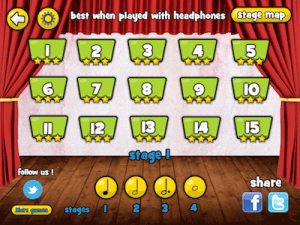
The free version of this app has 15 levels to try out and can be found here.  The Pro version (here) has four “stages,” with 15 levels in each stage.  Stage 1 uses basic rhythms, including crotchet rests and paired quavers.  Stage 2 introduces the dotted crotchet paired with a single quaver and also ties, to create syncopated rhythms.  Stage 3 introduces the quaver rest and complex time signatures (e.g. 3-13 is a killer – it mixes 3/4 and 2/4 and goes pretty fast).  Stage 4 continues with more advanced rhythms using three buttons.

Piano teacher Wallsend NSW

Developed in collaboration with professional musicians and educators, Rhythm Cat is an excellent app to use at home and in the studio.  Students will learn to look ahead more as they tap these rhythms, and will learn the important skill of listening to themselves and others (in this case, the soundtrack) to stay together.

If you are considering music lessons for your child or for yourself, please contact me to discuss the options. Piano lessons are conducted at my studio in Wallsend, NSW.


App Review “ScaleBlitzer” by BlitzBooks – Piano Teacher in Wallsend, NSW

I was a kid who, when it came time to study for school exams, would always pick maths first. Not because I was particularly good at maths or that it was my favourite subject (it certainly wasn’t). But to me it was about right or wrong. I had the answer right, or I had the answer wrong, so I knew how I was going. Maths had structure, order and logic and working my way through a list of problems was easy discipline.

Playing scales is, to me, a very similar discipline. You have a list of them and work your way through the list. If you play with the correct fingering you should end up finishing in the right place. OK, that’s probably a bit of a simplistic way of looking at it, but you get the point. Structure, order and logic. The things that suit my brain so well.

Piano Teacher Wallsend NSWI have posted before about how important scales are and why we play both them and arpeggios, but I am very aware that not everybody finds them quite as mesmerising as I do. Sometimes you need to kick things up a level. Add a bit of variety. That’s where the app “ScaleBlitzer” comes into the routine. I use this occasionally during lessons, but also encourage my students to use it regularly at home.

Enter all of the scales you have been given into your homework list and the app will generate a vast range of activities based on those scales. Basically, it throws them back at you in a random order, with added instructions. Mixing it up a bit. ScaleBlitzer remembers your homework and keeps track of your progress.

Piano Teacher Wallsend NSW

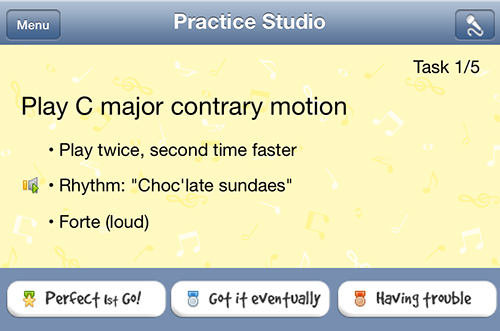
Once you enter the Practice Studio, there are five different modes from which to choose:

  1. Warm-up: Easy practice methods like ‘ascending only’, ‘play twice’, or ‘no blowing, fingering only’.
  2. Basic: No practice method given, just straight out no-frills instructions (e.g. like you would get in an exam).
  3. Muscle Builder: Practice methods using such things as rhythms and accents.
  4. Brain Strain: Harder practice methods, or a combination of two methods (e.g. in a certain rhythm AND staccato).
  5. Thrill Seeker: This mode will give you either really tough methods, or sometimes three different methods to incorporate into one scale.

The following is just a sample of the type of direction you may read:

  • Play twice, second time faster
  • Double staccato
  • Descending then ascending
  • Rhythm: “Seventy sixty fifty”
  • Play three times without stopping
  • Play twice, mezzo forte first time, piano second time
  • Accent: “Galloping galloping”

Piano Teacher in Wallsend NSW

One of the features that makes using this app interesting is the self-rating feature. After each scale, you need to select how you think you went – Perfect 1st go, Got it eventually or Having trouble – before moving on to the next one. As we know, effective practise requires listening to the way you’ve played something and deciding whether it needs more work or not. This self-rating system encourages listening and critical thinking, rather than just playing through.

The app remembers what you do well and where you have trouble and future sessions are based on where the work is needed. You will be tested more often on the ones you’re having trouble with, until they start to improve.

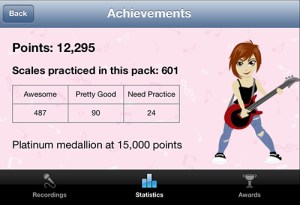
Along the way, points are accumulated and characters and outfits are chosen and changed. Once you have made it through a Practice Studio session (5 scales/activities), it will offer you the opportunity to go on a World Tour, where you can choose your character, outfit and the countries in which you will play. The kids love getting to this part and it’s lovely to see their inner rock-child or pop princess come to the fore in their outfit choices! You can even record your playing to show your teacher what you have been doing.

Piano Teacher Wallsend

Overall, the aim is to make technical work more interesting to play while having a bit of fun along the way. I like using it as a teaching tool because it makes my students stop and think about what they are playing. For students, your technique will be improving without you being bored. For parents, it’s a bonus to have any resource that makes the kids want to play instead of having to nag them. You will also know they are practising the scales that need the most attention, because ScaleBlitzer is keeping track of it. At the end of the day, improved technical work means improved technique, which results in improved playing. If we can add in a bit of fun and variety along the way, then we have a bonus!

If you are considering music lessons for your child or for yourself, please contact me to discuss the options. Piano lessons are conducted at my studio in Wallsend, NSW.

Adult Learners… the pros and cons – Piano Teacher in Wallsend, NSW

“You are never too old to set another goal or to dream a new dream.” – C.S. Lewis

How often do you hear friends and colleagues say, “I wish I hadn’t stopped learning …(insert a variety of past pursuits now inducing feelings of regret)? Often that wish is tied to a musical instrument. Because learning an instrument is hard work, often children give up before they have learnt enough to carry them through into adulthood and they stop playing all together.

Nearly a third of my students are adults and they are a really rewarding group. Learning an instrument as an adult has both pros and cons.

Nobody yells at them to practice, which on the one hand is very nice indeed. On the other hand, they have to be able to discipline themselves to do the job. Also, they are paying for their own lessons, so while footing the bill is not necessarily a positive feature, it’s easier to knuckle down to work when you understand the value.

One of the biggest challenges for adult learners is that their understanding is ahead of their physical reaction. Adults will often pick up theoretical concepts quickly, but they will develop technical and reading skills slowly and gradually. Unlike children who usually have nimble fingers and good technique but lack the emotional maturity to understand the musicality of the piece, adults can usually grasp intellectually how a piece of music should sound (e.g. playful, sad, lilting etc) but don’t have the skill on the piano to express it. This limitation is, of course, only temporary and will be overcome with time and practise. Physically, the body is usually more tight; as people age, they often cannot move their fingers fast enough to play at extreme tempos or their wrists may never loosen enough to provide good flexibility but there is still a lot of beautiful music to be made. There will always be pieces suited their physical level that can satisfy them emotionally and still challenge them technically.

Adult-oriented method books assume adults will learn a lot faster than children and this is not always the case. I have found it to be rarely so; adults may learn differently, but that doesn’t necessarily mean faster. Adult method books usually jump right in to using all five fingers on both hands – and reading nine notes – from the outset. For adults trying to learn something new on top of all the normal pressures of family, work, commitments etc, this can be overwhelming. I would prefer they start out with a sense of accomplishment rather than frustration. Consequently, a lot of the most helpful resources are very child-friendly and do not speak to you as an intelligent adult. But you do get some cute pictures!

Piano teacher in Wallsend, NSW

Adult student, Alan playing finger control exercises.

Adults learners can be fluid, flexible and adventurous and bring with them a strong motivation to learn. But they are also cautious, perfectionists and extremely hard on themselves. They are often very anxious to achieve their goals and it can be difficult to convince them they are doing well. Adult students are also better able to articulate their problems and understand practise suggestions, both benefits helping them to make consistent progress.

The best thing about learning to play the piano as an adult is that they are free to do as they please. Adults aren’t trying to please a parent, a teacher or an examiner. No one is forcing them to take lessons. It’s about them and the music. And that is a blessing 🙂

If you are considering music lessons for your child or for yourself, please contact me to discuss the options. Piano lessons are conducted at my studio in Wallsend, NSW or mobile lessons are available in the eastern suburbs of Lake Macquarie.


Encouraging More Practise – Piano Teacher in Wallsend, NSW

Establishing a practising routine can be hard work! Playing the piano is not easy and your kids will try all sorts of excuses to get out of practising. It is important to set practise time into their general routine so it has a place and is not just something that is done if they have leftover time.

Following are some tips to encourage more practise:

  • Never underestimate a reward system. Use whatever works for your child; it could be anything from extra iPad time to an exemption from a household chore. Their reward may even be a favourite meal.
  • Schedule practise time to happen before something they can relax with – free play time, for example. Of course, if you suspect this may lead them to rush through practise with no concentration, try another tactic.
  • Give your child something exciting to work for. Anticipation works wonders! Set a practise goal, wrap a little gift and pop it somewhere they can see it. Only when they reach the practise goal are they able to open their gift.
  • Connect their practise session with another activity that occurs every day. Perhaps your child could practise straight after breakfast or maybe before they start their homework. Whatever works for you.
  • Remember to reward yourself. This is your journey as well, so find something fun with which to reward yourself when you are successful at getting your kids to practise.

Piano Teacher Wallsend Newcastle NSW


A great little resource for practising tips for parents is the e-book “101 Piano Practice Tips”, which is available through Amazon.


If you are considering music lessons for your child or for yourself, please contact me to discuss the options. Piano lessons are conducted at my studio in Wallsend, NSW or mobile lessons are available in the eastern suburbs of Lake Macquarie.

Want to Reward Your Brain? Listen to New Music – Piano Teacher, Wallsend, NSW

Recently I attempted to have an MRI. I say ‘attempted’ because I failed. Miserably. Previously-unrealised claustrophobia swept in and took over… big time. Crying, sweating, shaking and stricken with headache and nausea, I was pretty quickly pulled out of the tunnel of terror and sent on my way.

But while I may now be overcome with unpleasant sensations at the very thought of an MRI (or any closed space) the technology is increasingly being used in research with very interesting results.

We all know it is impossible to listen to music and not be moved. What music moves us, how much and why are mysteries that have for many years intrigued both musicians and scientists. Last year a study* was undertaken at the Montreal Neurological Institute at McGill University in Canada to find out some of these answers.

Piano teacher Wallsend Newcastle NSWWhile most previous studies had used only strongly-emotive music, this study had participants bring in music they preferred. This ranged from classical music through to techno, country, film soundtracks and heavy metal. The participants were then studied using MRI while listening to 60 different excerpts of new music, based on their musical taste. They also had the option to ‘buy’ a song in a mock online store, based on the 30-second samples.
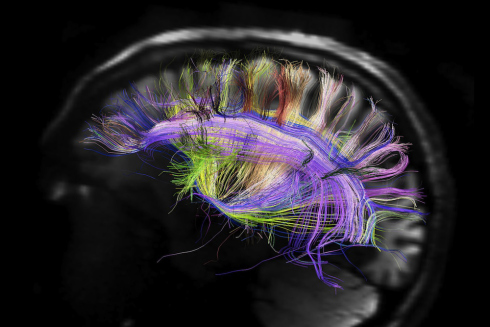
What was discovered was that a particular part of the brain becomes active when we hear a piece of music for the first time. This part of the brain is the nucleus accumbens, a zone that is operated by the chemical dopamine, which plays a major role in reward-motivated behaviour.

One of the researchers, Dr Valorie Salimpoor, said, “What’s cool is that you’re anticipating and getting excited over something entirely abstract – and that’s the next sound that is coming up.” The more a participant liked the music they were hearing, the more stimulated the ‘reward region’ of the brain became.

Because our brains are so well-suited to using patterns to predict what will happen next, we are constantly making predictions. Even if the piece of music we are hearing is new, our brains are predicting – based on past musical experiences – how it will unfold. If we enjoy the music more than predicted, the nucleus accumbens (partnering with pattern recognition and high-order thinking centres) fires off with delight.

“What makes music so emotionally powerful is the creation of expectations. Activity in the nucleus accumbens is an indicator that expectations were met or surpassed,” Dr Sapimpoor said.

So if you want to get that dopamine pumping and reward your brain, treat yourself to some new music. Launch your Spotify app or go through some recommendations in iTunes. You never know what joys you may discover.

And I promise you won’t have to visit an MRI machine to feel the benefits 🙂

Piano teacher Wallsend Newcastle NSW

Credit: Image courtesy of MGH-UCLA Human Connectome Project.

If you are considering music lessons for your child or for yourself, please contact me to discuss the options. Piano lessons are conducted at my studio in Wallsend, NSW or mobile lessons are available in the eastern suburbs of Lake Macquarie.

 
* The study is published in the journal, ‘Science”.
Salimpoor VN, Benovoy M, Larcher K, Dagher A, & Zatorre RJ (2011). Anatomically distinct dopamine release during anticipation and experience of peak emotion to music. Nature neuroscience, 14 (2), 257-262 PMID: 21217764

Think Long-Term – Piano Teacher in Wallsend, NSW

Remember the great info-graphic/picture from last week’s blog post that talked about all the ways learning music helps to train your brain?

There are so many benefits to learning to play an instrument, but they aren’t all going to happen overnight. As well as the cognitive training, the muscles required to play the piano need to be developed as does the control and coordination required to play.

Piano teacher Wallsend Newcastle NSWBecause of this, it is not really appropriate to take the, “we’ll try it for a few months and see how it goes” approach. The commitment needs to be made for at least a couple of years. It’s about being realistic about what it takes to gain musical skills.

Besides, you have made a substantial investment in not only time, but tuition fees, music and possibly even an instrument. You want it to be worth it!

If you are considering music lessons for your child or for yourself, please contact me to discuss the options. Piano lessons are conducted at my studio in Wallsend, NSW or mobile lessons are available in the eastern suburbs of Lake Macquarie.