
I know I talk a lot about practising, but it is so important I can’t ignore it. Practise is the vital component of being able to play well. The linchpin. The thing that brings everything else together.
You can have the best teacher in the world and turn up every week for your lesson, but if you do no work in between lessons, you simply will not improve. Because of this, I post often about practicing. Different tips and techniques will resonate with each person or family, so I like to throw into the mix as many ideas as possible.
These three points are not really tips, though – they are fundamentals. They are the three things I push with all my students from day one. I’m sure sometimes I sound like a broken record!
If you are having trouble with a particular passage, any one of these techniques will help and often a combination is even better:
Slow down
Slow down and take your time. It can be frustrating when you know how the piece sounds and you just want to play it at speed so the familiar sound and what you are playing are closer together. But playing too fast doesn’t allow you to really pay attention to what you’re playing or note the areas that need additional work.
It is not necessarily easy to play at a very slow speed and discipline is required, but once you see the value it is much easier to stick with the technique. Practicing slowly helps with a range of aspects:
- Establishing correct fingering;
- Phrasing;
- Wrist and arm movement;
- Understanding chord structure; and most importantly
- Note accuracy.
It allows the brain more time to comprehend every aspect of the piece and understand the overall picture or structure.
Physically, it can also help with tension. When we are playing a difficult passage, we will often subconsciously tense up and become stiff, particularly with fast sections. When playing slowly the body is more likely to relax, allowing for more freedom of movement and improved sound quality.
Speed can be built back up but bad habits are harder to unlearn. Also, your brain has already learned all the necessary movements so speed is just about thinking faster J
There is no such thing as too slow!
Count out loud
Even though I have been playing for over 40 years, I still find counting out loud is the easiest way to get my mind around a complicated new passage. It is particularly crucial for beginners and works excellently in conjunction with the point above about slowing down. Counting out loud helps develop a sense of rhythm; the physical act of counting makes the rhythm more dominant and the hands tend to follow.
As an extension, clapping the rhythm can also be useful; it allows you to hear and understand the rhythm before adding in the melody.
Separate hands
Similar to pulling difficult passages out of a whole song, playing with separate hands helps to reduce complexities into manageable tidbits.

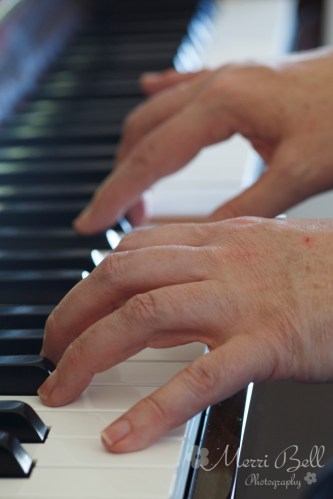
Practising the left hand separately.
Think about technical development in areas such as scales and arpeggios – it is always learnt playing with separate hands first. Even the AMEB technical syllabus introduces new concepts with separate hands for a grade/year before they are brought together the following year/grade. It is only once these techniques are mastered that the hands are brought together. In many cases this philosophy can be taken into the pieces we play as well.
Playing hands separately allows the muscle memory of each hand to be continually reinforced, which makes it easier to then bring them together.
Practicing hands together is not twice as hard as practicing hands separately—it is at least four times as hard. As your playing becomes more advanced you will come across pieces where each hand is a separate voice or voices, and you want to hear and understand how they sound in isolation so each one can be shaped into an independent voice before putting them together.
Separating the hands is useful in the majority of instances, but may not help in pieces where the melody is constantly flowing between the two hands.
So if you are struggling with a difficult piece (or passage), remember the three golden rules:
- Slow everything right down.
- Count out loud.
- If still having trouble, play each hand separately.
If you are considering music lessons for your child or for yourself, please contact me to discuss the options. Piano lessons are conducted at my studio in Wallsend, NSW.
 Having your piano in an out-of-the-way location. Having your piano or keyboard tucked away in a spare room or an area of the house not regularly accessed doesn’t encourage regular practise. Out of sight, out of mind! Have your piano in a prominent position in the house so it acts as a constant reminder.
 4. Encourage them to really listen to what they are doing… and listen yourself. If they play a section a few times and it changes from halting to fluent, congratulate and encourage them. Ask them what they are trying to achieve.
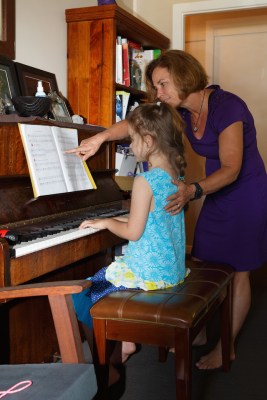 In this first part of a two-part post, we will look at some of the ways you can help your child that don’t involve the music itself. Part two (in two weeks) might surprise you with the ways in which you can be involved with the content of their practise.
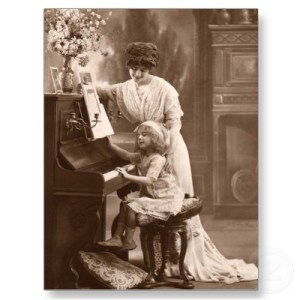 6. Ensure they are sitting correctly at the piano. Keep an eye on them and if you see them slouching, suggest they hold their back straight. This will not only stop body fatigue but will also help them balance their arms and hands properly. Their teacher should also be able to show you how they should be holding their hands, so you can keep an eye on that as well.
 Sometimes we just need to mix things up a bit. Practise can become mundane and boring and concentration wanes. I wrote two weeks ago about
 Why practice scales?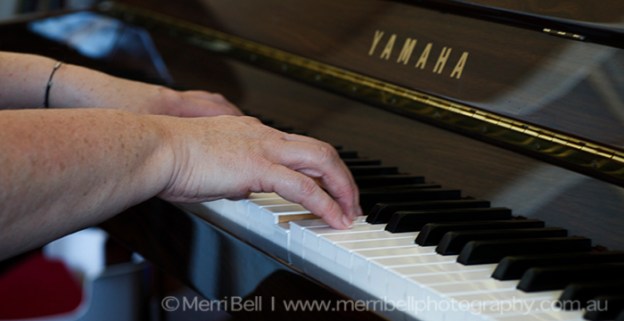

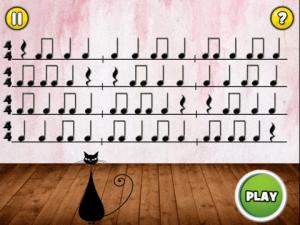 Rhythm Cat teaches and reinforces the most commonly-used musical rhythm notation. The free ‘Lite’ version has 15 levels while the ‘Pro’ version works up to following three different colours in each rhythm, encouraging co-ordination of both hands.
 The ‘Cat’ family also includes ‘Treble Cat’ and ‘Bass Cat’. I don’t tend to use Bass Cat with my beginners because it starts in a different octave, but Treble Cat is better suited. These games involve recognising the notes from amongst a group of notes, not just on their own. The notes also move slowly, giving you plenty of time to recognise the correct notes.
 A basic note recognition app, NoteWorks is customisable for difficulty, including clef/s and range of notes. The interface and sound effects are fun for younger students, but the app still moves quickly enough to be challenging for older students and adults.


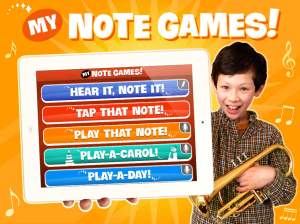 Tap that Note uses the device to identify notes, while Play that Note requires you to play to specified note on the piano (or whatever instrument you tell the app you are using). Play-a-day is a great sight reading exercise for intermediate students. As the name suggests, Hear It, Note It – also available as a standalone game – involves listening to what is played and notating it and has three difficulty levels within. Activities include tasks such as adding accidentals to correct a scale or completing rhythms with notes, rests and bar lines.
 While it does contain basic note recognition, Tenuto is really suited to more advanced students, as the majority of activities are more complex.

 merri bell music