
Sometimes you may feel as though you are beating your head against a brick wall. You set a practise schedule and you try to stick to it, but you just aren’t progressing. You could be making one of the following mistakes, all of which are easy to overcome:
Not actually practising. You intend to and you pop it into your schedule but it is never given the priority it requires and deserves. It requires a true commitment. Trust me, once you practise enough to get past those early learning hurdles, you will start to enjoy it much more and even look forward to practise.
Playing what you already know. It’s so much easier to keep playing the pieces you already play well and neglect the ones that require more effort, but you’ll pretty quickly become bored with your repertoire as well as not having a challenge.
Not reviewing old pieces to maintain a repertoire. Following on from the point above, you want to revisit older pieces occasionally so you can maintain a repertoire that has both volume and variety.
 Always starting from the beginning. If you start a piece at the beginning every time you play it, you will find you quickly become proficient at the start of the piece but less so as the piece goes on. I often tell my students to start at the part they find the most difficult, work on that part and then incorporate it back into the song.
Playing easier parts faster than the harder passages. If – as the point above suggests – you usually start at the beginning of a piece, you will probably play this part best and consequently a little faster. Then when you hit passages that require more concentration, you will slow down. From the time quavers are introduced to my students, I tell them to look at the hardest part (which at that stage is usually where the quavers are) and see at what speed they are comfortable playing that part. The rest of the piece is then played at this tempo. An added bonus is if that means the majority of the piece is feeling too slow, there is an added incentive to work on the troublesome section first to get it to the speed you want. Effective practise!
More common mistakes and how to fix them in a couple of weeks 🙂
If you are considering music lessons for your child or for yourself, please contact me to discuss the options. Piano lessons are conducted at my studio in Wallsend, NSW or mobile lessons are available in the eastern suburbs of Lake Macquarie.
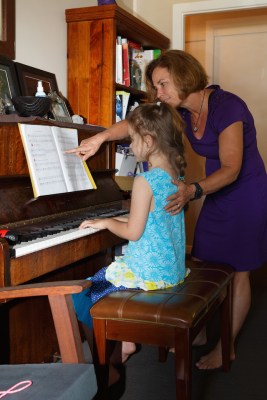 In this first part of a two-part post, we will look at some of the ways you can help your child that don’t involve the music itself. Part two (in two weeks) might surprise you with the ways in which you can be involved with the content of their practise.
 6. Ensure they are sitting correctly at the piano. Keep an eye on them and if you see them slouching, suggest they hold their back straight. This will not only stop body fatigue but will also help them balance their arms and hands properly. Their teacher should also be able to show you how they should be holding their hands, so you can keep an eye on that as well.
 Sometimes we just need to mix things up a bit. Practise can become mundane and boring and concentration wanes. I wrote two weeks ago about

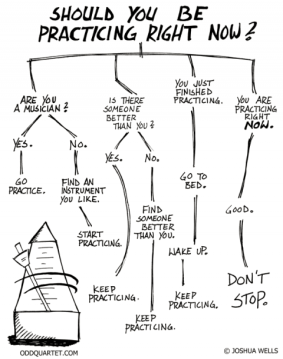
 Why practice scales?

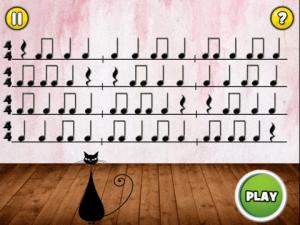 Rhythm Cat teaches and reinforces the most commonly-used musical rhythm notation. The free ‘Lite’ version has 15 levels while the ‘Pro’ version works up to following three different colours in each rhythm, encouraging co-ordination of both hands.
 The ‘Cat’ family also includes ‘Treble Cat’ and ‘Bass Cat’. I don’t tend to use Bass Cat with my beginners because it starts in a different octave, but Treble Cat is better suited. These games involve recognising the notes from amongst a group of notes, not just on their own. The notes also move slowly, giving you plenty of time to recognise the correct notes.
 A basic note recognition app, NoteWorks is customisable for difficulty, including clef/s and range of notes. The interface and sound effects are fun for younger students, but the app still moves quickly enough to be challenging for older students and adults.


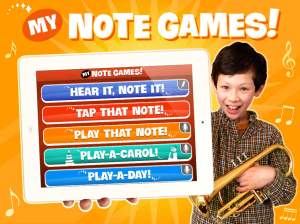 Tap that Note uses the device to identify notes, while Play that Note requires you to play to specified note on the piano (or whatever instrument you tell the app you are using). Play-a-day is a great sight reading exercise for intermediate students. As the name suggests, Hear It, Note It – also available as a standalone game – involves listening to what is played and notating it and has three difficulty levels within. Activities include tasks such as adding accidentals to correct a scale or completing rhythms with notes, rests and bar lines.
 While it does contain basic note recognition, Tenuto is really suited to more advanced students, as the majority of activities are more complex.

 In our late teens to early adulthood, these differences became our strengths. We worked together really well because we complemented each other and didn’t suffer from competition. Even when we sang, I sang the soprano to her alto. When she moved on to singing lessons, I accompanied all her practising. The picture on the right is a famous artwork that was on the cover of a card she once gave me.

